

 Posts
Posts


See also Peru: Amazon, Lima - Blog post part 2
December 15 - 23, 2018.
A spontaneous trip due to an overage of vacation time intended for moving in case I bought a house, but given the ongoing reorg with work and the low inventory of housing, this time slot appeared to be a great opportunity to finally see the Amazon and Machu Picchu, a trip I've always wanted to make. I managed to get the hepatitis A and yellow fever shots, didn't have time for typhoid, and all the prescriptions I would need including something for acclimation to high altitude (which I mostly noticed a little in Cusco), anti-malaria, and Z pack in case I got the shits.
Atlanta > Lima > Cusco > Aguas Calientes (2 nights) (small town at the foot of Machu Picchu) > Cusco (one night) > Iquitos (2 nights) (town opening into the Amazon) > Lima (one night) > Atlanta.
I booked my flights and hotels ahead of time, my tours were selected along the way in Peru.
Arrived in Lima late from Atlanta, had my flight to Cusco set so early the next day there was no point in sleeping. I went to look at people in Miraflores, found a discotech, wandered through a crowd of millennials as if invisible around 3am, went back to the airport.
Flight to Cusco was spectacular, didn't have a window seat, but could see snow capped mountains behind two guys who sat oblivious to the view, sleeping and looking at their phones, but proud to declare they were natives of Cusco.
Took a private car from Cusco about 2 hours to a train station. Dogs wandering all around, women in the traditional Peruvian garb carrying farm instruments, and random half-completed buildings all around with political campaign messages painted across them.
Arrived at a train to pass through the mountains, about an hour trip to Aguas Caliente. A guy from Colorado said he was approached by people selling coke and massages in Cusco. Over time, I began to get the sense that Cusco had a lot to see and do, and by the time I arrived I realized it's a much bigger city and a great destination, so I wish I had at least another day or two to tour.
The entire town of Aguas Calientes is surrounded by mountains, so the view from my hotel, Taypikala Boutique, was spectacular. The hotel was beautiful, excellent service, and reasonably priced.
I went to the hot springs and joined others in a pool, had conversations with a Canadian, several Germans, and a group from Cusco and Argentina, in my best broken Spanish. Then went to dinner at a restaurant called Mapacho. Had a couple of beers with rice and seafood and seafood soup. The seafood in the mountains obviously isn't fresh, but I couldn't complain. I ended up returning twice more to this restaurant, and during lunch had an entertaining talk with an American contract military pilot who apparently works 6 mo./year, is paid very well but bored and going through a divorce, so otherwise he spends his off months traveling and doing drugs. Brilliant guy, party animal according to his stories which I don't doubt one bit.
Next morning, up early for the bus to the top of Machu Picchu. Fortunately, the rain held out until noon, right about the time my tour ended. Highlight facts from the guide include that reputable scholars say there were couriers who would deliver messages to the top of the mountain from Cusco within five hours, running on 2 kg of cocoa. And, when he mentioned human sacrifice being customary, I asked how those beliefs translate to modern day. He stated that even today, bodies have been found and that there are areas that tourists shouldn't go alone. Witchcraft is known to still be in practice in certain areas and the shaman, though harder to find, are still established, and at various levels of expertise. One guy working in the hotel asked his son for the contact of a known shaman for me, but the guy wasn't available, he was in Lima.
One speaking convention I noticed with those who speak English is use of the Socratic method, or at least, to make a statement, throw in 'Why?' and then give an explanation. At first, it seems like an overused affectation of a guide, but then I encountered non-guides who spoke the same way, which I found hilarious. I need to start doing that myself because it really gets under the skin.
I had one long conversation with a guy in a restaurant using my best Spanish hackery to discuss the separation of Catholics and Incas, and he explained because it is one people, there is no conflict. I equated this to the Ethiopian and Somali people, who also live in harmony with a common culture. The conversation was interrupted by a guy selling paintings, and I ended up buying four at $80/ea, I'm sure I was taken, but I cannot regret, and ignorance is bliss. I did find the studio later in Cusco, and I'm certain I could have negotiated lower which I'm not inclined to do with an artist, assuming this guy was an actual artist himself.
I was discouraged by most people from going to the discotechs, which I would love to have seen because it is known to be visited by locals, but the action started later than I was willing to stay up for. So, I wandered around a little, and had a great moment with a dog. Again, dogs wander free through the town, friendly and playful, apparently they have owners to a degree, but certainly seem to be largely fending for themselves. I bought a ham and cheese for this beautiful shepherd dog, and it seemed to wander away without any concern, then it suddenly reappeared as I approached my hotel with an outpouring of gratitude and affection, nearly broke my heart. I gave it some water and it stayed by the hotel door all night according to the desk manager.
I learned from one waitress and one hostess that everyone in the town works 24 days consecutively, then takes four days off and most return to their homes in Cusco. The hostess is actually from Venezuela, a 21-year old girl with excellent English who hadn't completed university, and I met another Venezuelan in Iquitos, a civil engineer in his mid-thirties, both had only arrived within the last few months. I did meet one shop owner who is independent, so it's not a requirement to be employed by the town.
I spoke with a personable South Korean on my return train ride to Cusco, discussing his comparisons of dating American women vs expectations in Korean culture, then by bus into Cusco where I was the solo Gringo.
I stayed at the modest but comfortable Torre Dorada hotel, the owner is a sharp, well-traveled Polish business woman born in Cusco. Friendly staff, very helpful in orientation and transportation in Cusco. She had lived in Switzerland which she said is nearly a perfect country, and was frustrated with Cusco's lack of systematic operation.
I first went to tour the Temple of San Blas which was built in the 1500s, super elaborate woodcarvings covered in gold. Several amazing catherdrals and churches around Cusco, and the blending of Inca and Catholic imagery is interesting, but I felt so conflicted, feeling the magnificence of the Incan civilization, so crushed by the Spanish, yet also to recognize the dominance of what was a brilliant yet brutal, short-lived culture.
From there, I found various shops and had a traditional dinner at Pachapapa restaurant. Beautiful outdoor space with ambiance. Hard to remember what I had, a skewer with lamb, I believe, I didn't go for guinnea pig or other unusual food for this round.
Wandered through shops and found the masks of traditional Inca dances to be beautiful and fantastic. Was approached by a guy selling whatever drug anyone might want, and declined, but he did direct me to an excellent tattoo shop where I had a very enlightened conversation with one of the partners who specializes in piercings. I mentioned liking the Incan iconography and he produced a reference book and suggested a particular diety which I liked but there wasn't enough time and I'm not sure I'd make such an impulse decision regardless. Went to one discotech which was sparsely populated and went to sleep early enough in hopes of using up what little time I had the next morning to see Cusco before my flight around noon. Unfortunately I missed seeing the Sacred Valley and many other ruins, the traditional Incan dances, and so many other things to see.
Next day really made me wish for more time in Cusco, so many beautiful shops and people, I could wander the streets forever and never get tired of it. Visited one other church, then an Inca museum which was worthwhile. Then my flight to Lima, where I found myself sitting in a mall for many hours killing time, because when I arrived in Lima I learned my flight to Iquitos was delayed until around 1020PM.
I was somewhat disappointed to find so many fast food chicken places in the food court, including Popeye's and KFC. I was ultimately able to get some decent traditional Peruvian food and charge my phone.
I arrived ten minutes late at the airport due to crazy traffic and a confused taxi driver, but I had already checked in, so I was confused when the guy told me I couldn't enter because the check in was closed, and I was almost being scheduled to fly the next day. After some explanation with another guy, I suggested running to make my gate which I did, only to find that the flight had been moved once again to 1AM. By this time, I was just happy to make my flight.
The people were so upset about the delays that they were chanting like an organized protest, the police were called in, it was ridiculous. When I asked if anyone spoke English to explain the situation, the police and one fat piece of shit of a woman with a big tattoo, all, were happy to tell this Gringo 'Spanish', she was one of the loudest protestors but she enjoyed giving me the hand with the cops standing beside her. Perhaps the cops thought I'd be complaining since the crowd was so unruly, but I got the sense they prefer that I start the conversation in Spanish, which I usually did. We all arrived around 4am in Iquitos.
I stayed at Doubletree Hilton, great location in town, good price and very nice as expected. Great breakfast and conversation with three well-educated, young Peruvian sisters with Libertarian leanings. Then met with a guide recommended by the hotel, and I chose to visit a market that should be accompanied with a guide only, and a trip into the jungle the next day. I paid a little extra hoping they would be appreciative and attentive, not sure if it was necessary, but the two guides were equally excellent - personable and thoughtful - both born and raised in the jungle.
My first guide is 27 years old with a 2-mo. old baby. He offered to take me 8 hours boat ride into the jungle to stay at his village, but I didn't have enough time. I would have LOVED to see his village.
We went to the market via Tuk Tuk (motorcycle taxi) and spent the entire day wandering through - the entire area eventually ends up underwater during the rainy season. The guide left his jacket at his uncle's space who lives in the market. Apparently the market is dangerous for tourists because of theft and robbery. There was a section of used clothing, meats and produce, medicinal plants and herbs including several hallucinogens used in various rituals including Ayahuasca which is taken under supervision of a shaman, and a black market which included various animals that are illegal to sell. Ayahuasca is said to cause severe vomiting, and I met many locals who have used it, saying it produced an out of body experience, unlike San Pedro (mescaline) which is more of a euphoric but powerful feeling much like LSD. Although I don't smoke cigarettes, I bought a pack of cigarettes, and I also bought some kind of hallucinatory tobacco that was wrapped in a leaf, although I didn't use it either, I gave away both to the hotel attendants. The idea with the hallucinatory tobacco was to focus on locating something that was lost or for example, someone who took your wife, then you smoke and you will have a dream in which the lost item or person will be revealed.
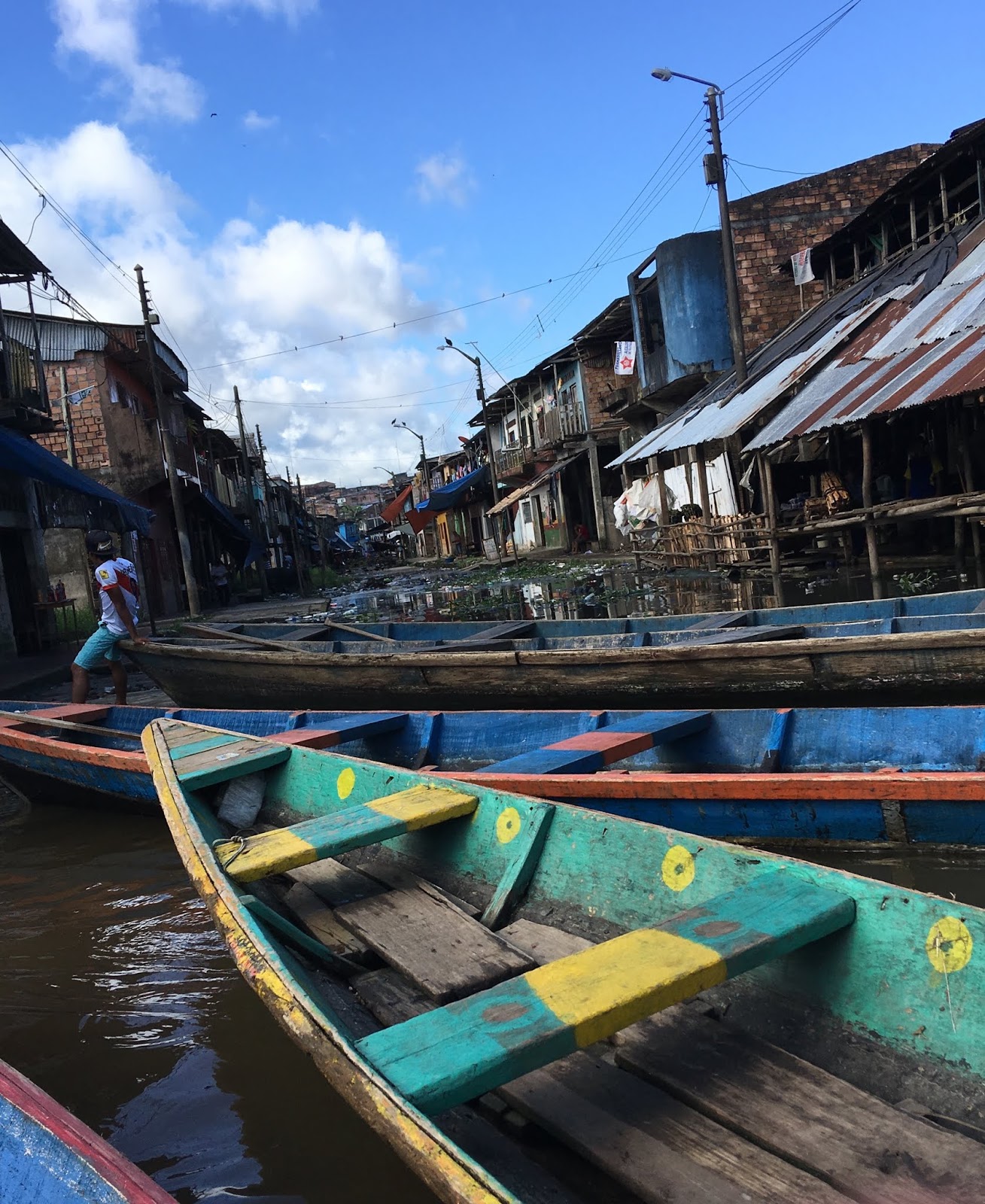
The black market is disgusting and filthy, yet completely beautiful, full of all kinds of characters. We made our way to a river (not the Amazon) and went by boat through a channel of floating houses. We returned to the market, wandered some more, and finally, ascended a catherdral and had a view of the entire city, then walked several blocks through a more commercial merchant area outside the market and back to the hotel.
That night, I went looking for a restaurant called Ikiitu, known for traditional cuisine. I ordered catfish which was a little tough in texture but very flavorful, and turtle soup which tasted a lot like beef. The waiter was a 21 year-old guy, very bright, studying English online through University of Michigan with an Australian teacher. I told him I wanted to see the discotechs and he asked if he could meet me out, so we met and went to see another place. The one we landed at was a mixed crowd, all locals, I was the glaringly obvious gringo. He was with a group of young friends passing around one cup by which they shared and refilled beer, and they all smoked weed. I didn't partake of anything, knowing I had to be up early, but noone was offended. We left late and went to a restaurant for burgers and talked about American culture and he was specifically interested in racial tension in the U.S. I ended up with 3 hours of sleep before meeting my second guide at 7am the next morning.
The guide took us to another market where I saw a few more odd items, and we boarded a boat and headed down the Amazon. I was impressed that the guide didn't stay on any trails, just roamed into whatever direction he chose with his machete, stopping for various reasons hoping to see whatever, tarantula, monkeys, birds.
The conversation highlights with this guide were about life in the jungle. What do they teach the children? How to use a machete, and how to avoid getting lost in the jungle. Everything one needs is available in the jungle. His grandfather is currently 93 years old and stopped climbing trees at age 65. They typically eat fish and bananas, twice per day. Other foods include fruits, potatoes, monkey, and tarantula which tastes like popcorn, and apparently not so many vegetables.
When he began working as a guide in the city, he was teased for being skinny, so he began eating more rice, and he began putting on more weight and had more energy for soccer. We talked a lot about this and I encouraged him to keep in mind the age and health of grandfather. This was the major theme of the jungle for me - the conflict of city vs nature - again, like the Spanish vs the Inca, I felt conflict. This guide has three children. We spoke a lot about his relationship with his wife and he sent me a link to his website which he built himself by watching youtube videos.
At the end of our jungle walk we stopped at a thatched hut lodge where we had a lunch prepared and I ate some piranha which was as tasty as any fish I've ever had. The trip back to Iquitos included a brief attempt to stop and fish for piranha, with no luck, and a sighting of a pink dolphin. We acquired one additional passenger who was living in the jungle area for four years, having left several careers living in Ireland after fleeing his home war-torn country of (cannot recall which country, somewhere in the Balkans) after losing all friends and family. He was happily living day-to-day experimenting with various medicinal plants with which he 'communicated'.
And finally, the hilarious antics of the now completely drunken boat driver who was producing quite the caricature, speaking to each of us at length in dogmatic and zealous Spanish, most of which I didn't understand, but was nonetheless quite amused and not bothered by, overall.
I arrived back to my hotel with enough time to shower by the pool, albeit without soap, just rinse, to get the mosquito repellent off. I was pleased that the combination of repellent and coverings were enough to keep me bite-free, the occasional flick of my hat brim enough to scatter the cloud of bugs away from my head.
Great conversation with a native man of Iquitos and also having divided time in Spain, probably in his sixties, excellent English, upon arrival in Lima we shared a cab to Miraflores.
I slept in and the next day made it to the seaside. The walk was lined with beautiful but simple homes, and I found one small convenience store tucked in between that carried various produce including the black corn which I'd never seen. Maize. At the seaside cliff, I watched paragliders and surfers, then found a fantastic nearby restaurant which I regret not recalling the name, Inca-themed, where I finally had ceviche, medium spicy which was plenty damn hot, seafood and rice, a side of white maize which is nothing like corn in taste or texture, and two desserts - one made from black corn and another which tastes like butterscotch pudding.
My walk back was a little uncomfortable and by the time I reached the hotel, I realized I finally had the squirts, which came and went, ultimately accompanied by three bursts of vomiting after which I felt better, then worse again. I was afraid I'd be unable to fly, and upon exiting my taxi to the airport, I immediately launched another five blasts, conveniently puking into a gutter directly behind us. The driver was simultaneously informing me between gushes that he expected 100 soles which is about 60 more than usual fare since it was the hotel's cab. Thankfully, I had no further vomiting on the plane ride (one additional bout of the squirts) but my nausea and dehydration made me quite anxious to arrive home from this very confined amount of space on this six hour flight. But enough about me.
Some observations about traffic in Lima. The cars are all small, manual transmission, and they move the way people move in a crowd at the mall, not necessarily in lanes, and mostly accommodating as needed, beeping to communicate as opposed to laying on the horn in anger. Although, at night I did observe some shouting and blaring horns, considering Lima has a population of 10 million, I conclude they are overall behaving well, especially compared to in the U.S., and my city in particular, population 486k, with SUVs, racing motorcycles, and road rage.
Apart from my surprise ending, which in a way was miraculous not to have happened sooner, my trip was a constant barrage of compelling imagery, and I never regretted traveling alone. I had many opportunities to use my Spanish which gave me the feedback to realize I speak more than I might have thought. I would like to have had an additional couple of days in Cusco and in Iquitos, but given the short notice, I feel more than satisfied with my experience.
Aguas Calientes
 |
| Train ride to Aquas Calientes |
 |
| Aquas Calientes street |


Cusco
 |
| Masks used in traditional Incan dances |
 |
| Night walk in Cusco, lights on the mountain |
 |
| Church in Cusco square |


 |
| Weaving at the Inca Museum |


Iquitos
 |
| Plaintains, one giant bunch for 10 soles ($3.30) |


 |
| This guy appeared drunk and pointing for me to go away, so I paid him 5 soles to take his photo. At least his expression says he means business because he's doing the Obama face. |
 |

 |
| We left this dock to see the floating village |
 |
| This guy was drinking in a small bar with a friend, dancing to Young Turks by Rod Stewart |
 |
| Hallucinogens in the black market. |
 |
| Mescaline powder from the Sand Pedro cactus |
 |
| To be used with guidance from a shaman, causes vomiting and out of body experiences, often used in tribal rituals |
 |
| Turtle soup for dinner at Ikiitu restaurant, tastes like beef. |
See also Peru: Amazon, Lima - Blog post part 2


