Showing posts with label language. Show all posts

Wednesday, June 3, 2020

How to use SIRI voice-to-text, reference and rules for dictation


For me, texting manually is painfully slow and riddled with errors, so I rely on voice-to-text with some editing as needed. Overall, it's effective, but often it produces some bizarre results.

I often wonder what rules govern voice-to-text when using Siri, which clearly isn't contextually aware, I would estimate far from NLU, and makes some outright weird interpretations.

For example, when I'm meaning to say 'many' but Siri writes 'mini', though this isn't consistent either. I'm unclear whether it depends on how I pause or how I pronounce, though my own pronunciation seems consistent to me. I end up guessing how to trick Siri into doing what I want.

Regardless of pace of speech or enunciation, there are many words or perhaps phrases that it simply cannot handle, such as misunderstanding 'I' with 'are' at the beginning of a sentence. Sometimes, Siri puts in random names in place of words, or injects popular phrases in place of standard language. I get the impression the collective jargon has a bigger influence than any standardized language reference. And, personally, I don't wanna represent myself in this manner, I want to represent myself like an upright, civilized human being.

Here's some reference:

https://www.oreilly.com/library/view/iphone-the-missing/9781449372781/ch04.html


https://www.macworld.com/article/2048196/beyond-siri-dictation-tricks-for-the-iphone-and-ipad.html

https://www.imore.com/how-use-dictation-mac

This is more about voice control and the part on speech-to-text is brief:
https://www.apple.com/macos/catalina/docs/Voice_Control_Tech_Brief_Sept_2019.pdf


Sunday, October 30, 2016

Natural language processing (NLP) + deep learning vs. natural language understanding (NLU)

AT&T + IBM = IOT dev. (July 2016)
http://www-03.ibm.com/press/us/en/pressrelease/50168.wss
http://www.ibm.com/internet-of-things/iot-solutions/watson-iot-platform/

IOT dev platforms: M2X & Flow Designer:
https://www.business.att.com/enterprise/Family/internet-of-things/iot-platforms-development/

--

https://en.wikipedia.org/wiki/Natural_language_understanding

--

AT&T Watson 

About AT&T Watson:
http://www.research.att.com/projects/WATSON/index.html

AT&T WATSONSM is AT&T's speech and language engine that integrates a variety of speech technologies, including network-based, speaker-independent automatic speech recognition (ASR), AT&T Labs Natural Voices® text-to-speech conversion, natural language understanding (which includes machine learning), and dialog management tasks.
WATSON has been used within AT&T for IVR customers, including AT&T's VoiceTone® service, for over 20 years during which time the algorithms, tools, and plug-in architecture have been refined to increase accuracy, convenience, and integration. Besides customer care IVR, AT&T WATSONSMhas been used for speech analytics, mobile voice search of multimedia data, video search, voice remote, voice mail to text, web search, and SMS.

Name origin: Alexander Graham Bell's assistant, Thomas A. Watson. VS. IBM's first President, Thomas J. Watson:
http://languagelog.ldc.upenn.edu/nll/?p=3918

--

http://www.interactions.com/press-releases/interactions-closes-strategic-deal-acquire-att-watson-speech-recognition-natural-language-understanding-platform/

2014
http://about.att.com/story/att_and_interactions_agree_to_strategic_transaction_in_speech_and_multi_modal_technology_arena.html

Video from 2012


--

Company claiming to have natural language understanding:

http://venturebeat.com/2016/08/11/deep-learning-alone-will-never-outperform-natural-language-understanding/

http://www.businesswire.com/news/home/20160712005547/en/Pat-Reveals-Radical-Breakthrough-A.I.-Launches-API

http://pat.ai/


Sunday, October 9, 2016

gesture and machine personality


I saw reference to a 'CNC machine', and I had no idea what it was. So, I googled, and it came up on youtube.

After watching, I realized this is totally my sense of humor, and I had to think about why.

Particularly, the surprise of not knowing what was coming and the revelation of the creation in 'mind' is funny. The moment the tool changes indicates when it's time for the next action, but my imagination has to immediately fathom what the tool is going to do before it shows me. Then, it begins the execution with utmost precision and zeal.

Watching a person do anything creative can be just as funny and fascinating if you don't know what they have in mind. If you do know, for example, a person is going to draw, but you can't tell what they are doing until it takes more form, the surprise is in observing where they begin, maybe compared to how I myself might think to begin. 

The same kind of effect can be achieved by watching three people perform the same simple, familiar task - washing hands, typing, tossing something in the trash, shaving, selecting food from a buffet, running or walking, scraping the last bite of yogurt from the bottom of the cup. I always wanted to make a montage of this kind of activity because the comparison reveals personality through gesture, pace, intensity, hesitation, the thought process and decision making, the level of attention, any addition of subtasks, and criteria for satisfying the given task to completion. Such purely absurd actions sometimes render performers into ridiculous caricatures as they submit to whatever method necessary to achieve the desired outcome.

One of the more hilarious such tasks is the act of licking an envelope. At the post office, I've witnessed some who lick their finger and press it across the glue strip, which strikes me as unhygienic, though perhaps they are either avoiding the taste, or trusting the sanitation of their own finger over the envelope. I myself would run my tongue up one length of the glue strip from end to center, then again to complete the other side, and I believe this to be the most thorough and efficient. However, I observed one person licking in rapid upward strokes across the glue strip, the way a dog pesters its owner for attention. This very energetic and frivolous performance was exacerbated by his being a fat, buck-toothed fry cook with rolls of neck fat covered in spiny crew-cut hair buckling from under a mesh ball cap. 

But, back to the CNC machine. A machine's movement is funny because of the precision, and because of the timing. There are moments of perceived finesse and brutality - the most precise, micro movements reading as meticulous and sensitive, and the macro movements seeming merciless, frighteningly relentless and forceful as teeth bare into metal the shards are cast away, appealing to my dark humor. Robots and machines might read as ultimate OCD introverts in that they exhibit strong intention and superior decisiveness, yet have no sense of self awareness, and are only concerned for monomaniacally focusing on the task at hand, like some kind of an autistic adolescent. 

In this instance, the automated task is funnier because there is no processing, no evaluation, just sheer execution. The only pause is when the next tool rolls out to begin the next task, and though it's a mere formality, it invites us to personify the machine as sentient.

Bear in mind, the machine is operated by a human, but it is performing a sequence of tasks previously handled by a human. Comparing human and machine performance of this operation might be funny by contrast, but the darkness in the humor would be stark.


Monday, September 12, 2016

universal human language

http://www.telegraph.co.uk/science/2016/09/12/humans-may-speak-a-universal-language-say-scientists/


Humans may speak a universal language, say scientists 


Humans across the globe may be actually speaking the samelanguage after scientists found that the sounds used to make the words of common objects and ideas are strikingly similar.
The discovery challenges the fundamental principles of linguistics, which state that languages grow up independently of each other, with no intrinsic meaning in the noises which form words.
But research which looked into several thousand languages showed that for basic concepts, such as body parts, family relationships or aspects of the natural world, there are common sounds - as if concepts that are important to the human experience somehow trigger universal verbalisations.
"These sound symbolic patterns show up again and again across the world, independent of the geographical dispersal of humans and independent of language lineage," said Dr Morten Christiansen, professor of psychology and director of Cornell's Cognitive Neuroscience Lab in the US where the study was carried out.  
"There does seem to be something about the human condition that leads to these patterns. We don't know what it is, but we know it's there."
The study found, that in most languages, the word for ‘nose’ is likely to include the sounds ‘neh’ or the ‘oo’ sound, as in ‘ooze.’

The word for nose is similar across thousands of languages 
Similarly, the word for ‘leaf’ is likely to include the sounds ‘l,’ ‘p’ or ‘b’ while ‘sand’ will probably use the sound ‘s’. The words for ‘red’ and ‘round’ are likely to include the ‘r’ sound.
"It doesn't mean all words have these sounds, but the relationship is much stronger than we'd expect by chance," added Dr Christiansen.
Other words found to contain similar sounds across thousands of languages include ‘bite’, ‘dog’, ‘fish’, ‘skin’, ‘star’ and ‘water’ The associations were particularly strong for words that described body parts, like ‘knee’, ‘bone’ and ‘breasts.’
The team also found certain words are likely to avoid certain sounds. This was especially true for pronouns. For example, words for ‘I’ are unlikely to include sounds involving u, p, b, t, s, r and l. ‘You’ is unlikely to include sounds involving u, o, p, t, d, q, s, r and l.
The team, which included of physicists, linguists and computer scientists from the US, Argentina, Germany, the Netherlands and Switzerland analysed 40-100 basic vocabulary words in around 3,700 languages – approximately 62 percent of the world's current languages.
The researchers don't know why humans tend to use the same sounds across languages to describe basic objects and ideas.
But Dr Christian said the concepts were important in all languages, and children are likely to learn these words early in life.
"Perhaps these signals help nudge kids into acquiring language," he added: “Maybe it has something to do with the human mind or brain, our ways of interacting, or signals we use when we learn or process language. That's a key question for future research.”
One of the most basic concepts in linguistics is that the relationship between a sound of a word and its meaning is arbitrary. However recent studies have suggested that some words may share common sounds,
For example researchers have shown that words for small spiky objects in a variety of languages are likely to contain high-pitched sounds, while rounder shapes contain ‘ooo’ sounds, which is known as the ‘bouba/kiki’ effect.


Spiky objects ten to have 'kiki' sounds
Dr Lynne Cahill, a lecturer in English Language and Linguistics at theUniversity of Sussex said it was possible that some words were similar across languages because they are the first noises children make. So the ‘ma, ma, ma’ and ‘da, da, da’ sounds made be babies became mama and daddy.
But she said it was too early to say there was a universal root for other words.
“You could argue that the words chosen here are very old and therefore most likely to have a common ancestor language in the past, from which they all derived,” she said.
“I think this is an interesting study which has looked at so many languages but I don’t think it quite justifies their claim that it debunks the idea that language is arbitrary and I think they looked at too few words to make any firm conclusions.”

Tuesday, December 8, 2015

word of the day - Stochastic

Use in a sentence: "You stochastic I wanna have yo baby".

Google search this word and the first thing that comes up is an audio clip of the pronunciation - the guy sounds very happy, and even pleasantly surprised. For the life of me, I cannot find that source file.

Other examples of 'stochastic' in a sentence:

"Dude, Neil's drumming is you know, like, really stochastic, he's so original. Dude."

"I might be willing to dismiss her mannerisms as mere eccentricities if they were even slightly more stochastic, but no, she's consistently annoying as hell."

"Stewart was stoked stupid by the stochastic staccato stitching in Stephanie's stylish stagger-step stockings."

Sunday, December 28, 2014

'Jueputa' Explained


Most people in the U.S. who have learned a little Spanish have likely picked up at least a few profanity gems. Most of us start with 'ca ca' and eventually work our way to 'puta', 'puto' or the beloved 'hijo de puta'. But, let's not get confused when we go a bit further south of the border.

My Colombian friend and I were discussing the phrase 'hijo de puta' and I was encouraged to use the abbreviated expression 'jueputa'. I wanted to text the phrase to show some appreciation, and I wasn't quite sure how to spell it, so I began my journey online and uncovered a treasure trove.

First, I found this page which offered a clue:
http://www.urbandictionary.com/define.php?term=hijo+de+puta


HIJO DE PUTA: 'hijoeputa' or 'higueputa', spanish word meaning 'son of a bitch'.

Not quite satisfied, I searched for 'higueputa' and found 'hijueputa', a variation on the spelling, which is abbreviated as 'jueputa'. Bingo.

http://www.urbandictionary.com/define.php?term=Hijueputa

The phrase 'jueputa' is a blend of words from different origins.

Spanish 'hijo' (son) crosses over with variations on roots of the English word we know as 'hag' which became 'higue' when Europeans arrived in the Caribbean, then later took on the Latin twist, 'hijue', before contracting to 'jue'. So,  just add 'puta' as a chaser and you are ready to serve up a round of 'jueputa'. Here's the wiktionary entry for 'jueputa' to confirm conclusions about abbreviation.

(hijo de puta = higueputa = hijueputa = jueputa = jue).

Although we recognize the word 'puta' to be the Spanish equivalent to the English word 'bitch', we lose some meaning in translation, that it doesn't in fact mean 'female dog', but according to Urban Dictionary, 'puta' is short for spanish "prostituta" which means prostitute. The implication and agreement of both 'hag' and 'bitch' in this phrase is actually 'whore / prostitute'; 'hag-whore', or 'son of a hag-whore'. The phrase is employed like any good expletive. 

e.g. Upon smashing his thumb with a hammer, Juan cursed "Aye, jueputa!".

Actually, I recall working with a Mexican guy who used to say '¿Qué onda?, jue?' which I suppose meant 'What's happening, son of a bitch'. 'Onda' translates via Google as 'wave' and I found a reference online that suggests 'what's shaking'.

According to the wiki on hag:

The term appears in Middle English, and was a shortening of hægtesse, an Old English term for witch, similarly the Dutch heks and German hexe are also shortenings, of the Middle Dutch haghetisse and Old High German hagzusa respectively.[4] All these words derive from the Proto-Germanic *hagatusjon-[4] which is of unknown origin, however the first element may be related to the word "hedge".
(end wiki)


...interesting that the derivation of 'hag' leads the root of the word 'hex' and carries the association with the occult. Also, that this same root relates to 'hedge' which represents an enclosure, barrier or form of protection. Notably, The Hague means 'hedge'.

According to wiki, the word 'hag' is used interchangeably with 'crone', is associated with misogyny, and refers to a woman who is 'marginalized by her exclusion from the reproductive cycle, and her proximity to death places her in contact with occult wisdom'.


...when I looked up the word 'higue', I encountered many references to the legends in Guyana including this one:
http://www.gotoguyana.org/myths-and-legends/old-higue/


I also found this on wiki:

http://en.wikipedia.org/wiki/Soucouyant

 
The soucouyant or soucriant in Dominica, Trinidadian and Guadeloupean folklore (also known as Ole-Higue or Loogaroo elsewhere in the Caribbean), is a kind of blood-sucking hag.

Legend

The soucouyant is a shape-shifting Caribbean folklore character who appears as a reclusive old woman by day. By night, she strips off her wrinkled skin and puts it in a mortar. In her true form, as a fireball she flies across the dark sky in search of a victim. The soucouyant can enters the home of her victim through any sized hole like cracks, crevices and keyholes.

Soucouyants suck people's blood from their arms, legs and soft parts while they sleep leaving blue-black marks on the body in the morning.[3] If the soucouyant draws too much blood, it is believed that the victim will either die and become a soucouyant or perish entirely, leaving her killer to assume her skin. The soucouyant practices witchcraft, voodoo, and black magic. Soucouyants trade their victims' blood for evil powers with Bazil, the demon who resides in the silk cotton tree.[3]

To expose a soucouyant, one should heap rice around the house or at the village cross roads as the creature will be obligated to gather every grain, grain by grain (a herculean task to do before dawn) so that she can be caught in the act.[3] To destroy her, coarse salt must be placed in the mortar containing her skin so she perishes, unable to put the skin back on. Belief in soucouyants is still preserved to an extent in some Caribbean islands, including Dominica, St. Lucia, Haiti, Suriname and Trinidad.[4]

The skin of the soucouyant is considered valuable, and is used when practicing black magic.

Origin

Soucouyants belong to a class of spirits called jumbies. Some believe that soucouyants were brought to the Caribbean from European countries in the form of French vampire-myths. These beliefs intermingled with those of enslaved Africans.

In the French West Indies, specifically the island of Guadeloupe, and also in Suriname, the Soukougnan or Soukounian is a person able to shed his or her skin to turn into a vampiric fireball. In general these figures can be anyone, not only old women, although some affirm that only women could become Soukounian, because only female breasts could disguise the creature's wings.

The term "Loogaroo" also used to describe the soucouyant, possibly comes from the French mythological creature called the Loup-garou, a type of werewolf, and is common in the Culture of Mauritius. In Suriname this creature is called "Asema".

(end wiki entry)


Wednesday, February 13, 2013

‪Rappin' for Jesus‬


http://www.westdubuque2ndchurchofchrist.org

http://www.theweek.co.uk/us/51477/rappin-jesus-makes-pastor-jim-youtube-star-video

http://now.msn.com/rappin-for-jesus-video-uses-n-word-likely-fake

--

Regarding controversy over use of the 'n' word.
Be sure to listen to the audio in the right panel.
http://en.wikipedia.org/wiki/Nigga

--

And, here's one English teacher who had to offer his own explanation to differentiate the two words:


...one more to challenge how this word gets used:


2 Nigga or Not 2 Nigga

The defense for using the slang 'nigga' is usually based on the notion that the black culture is entitled to reclaim the word and that they alone have that right because it has been used abusively against them.

On the other hand, for non-blacks who are raised by families who educate their children about the history of slavery and racial violence, the derogatory word 'nigger' or 'nigga' is considered profanity and is offensive, regardless of who is using it. Accusations of racism directed towards such individuals are highly offensive and liberal use of the word 'nigga' or 'nigger' can be considered insensitive and even a form of racism, as though the logic is that a profane word can be used in their presence simply because they are white (or non-black), as though they deserve such disrespect because of their guilt by association.

Whites have even been accused of voting for Barack Obama based on "white guilt". For some so called 'liberals', this may be true - the fear of being accused of racism by mere association - to the point of bending themselves into submission rather than assuming a position of integrity, whereby they begin aggressively accusing others of all forms of discrimination and finding ways to employ the line of attack for political gain. Democrat or Republican, both parties seek out voting blocks and pander with whatever symbol people will buy. Republicans are really jumping on the Latino vote. Nothing against Latinos, but what's the real agenda? Power?

But, back to 'nigga'...

Is the assumption by blacks who use the word 'nigga' in front of whites that all whites are racists who need the word taken from them? Or that they deserve disrespect as a form of emotional reparations for the wholesale acts of abuse committed by members of their race? Is it really that conscious an act of defiance? It always sounds so casual. Is it possible that blacks use the word 'nigga' because it means black and they identify with the word culturally in the context of living in a largely white country? It's comical when I hear a black person saying 'get your black ass over here' or 'you're as black as the ace of spades' - there is certainly a cultural preoccupation based largely on being a minority, a different focus from being oppressed.

Further, racial accusations made for gain - aka "playing the race card" - are doubly offensive. For an English teacher whose job is to correct language and make those who are uneducated conscious of their use, I think this guy has some balls, common sense and humor, but the system doesn't know how to address this issue formally without fearing lawsuits. In this case, the guy was suspended for ten days.

And that's how institutions and countries can be controlled, that's how the British Redcoats who marched in rows out of convention of honorable warfare were picked off from behind the trees by Americans in buck skins. What Somali pirates? We look the other way when we run the risk of overstepping our territory or infringing on others, sometimes at great costs. Sometimes we have to pick our battles. Discernment. Hostility. North Korea makes threats and we ignore them or the UN 'strongly condemns'. China? Tick tick tick.

OK, back to 'nigga'...

To put everything into context, the use of the word 'nigga' is largely recognized as popular jargon by people of any race or ethnicity, so with a little common sense and a sense of humor, one can afford to take it for what it's worth  -while also keeping it in context - and should not be offended, right? Yet, the double standard erupts into question constantly, and calls for reconciliation. Muslim extremists never took an ambiguous stance on making cartoons about Allah, only to go off and run a strip or gag panel in Al Jazeera. It's the elephant in the room, and depending on which generation someone is born into, I've encountered whites who do not understand the pop reference and who find the videos outright offensive. I could not adequately explain how it could possibly be justifiable or funny, the word is so taboo. But new generations move forward and we adopt new practices and perhaps this represents progress.

I must admit, I find the fist bump self-defeating, but it gets offered up daily by people of all races and ages, though it is associated with street culture and hip-hop. At times, I've offered a handshake and have been met with a closed fist in response, which frankly reads as a form of 'no agreement'.  Granted, if someone offers the fist first, I've been inclined to respond in kind, or even simply lay my hand over the fist in some vain effort to symbolically turn the tide of disconnection. Is it really about not having clean hands on the street, so I've heard, or is it more about the symbol of the fist? Wasn't the intent of the handshake to establish a means of demonstrating safety and trust between strangers, that each party is not holding a weapon in their right hand? Or is it simply the less gushy form of a hug, as people suggest when describing the proper amount of pressure to exert in a handshake. Maybe I'll start toting some hand sanitizer and we'll all begin bonding again, because clearly as Americans we all just want to cuddle. Wiki has a few ideas about how fist-bumping came about.  Maybe the East has it right - just bow, but be sure to keep your eyes on the other person.

Regardless, words and gestures are all part of the meme pool and people adorn themselves with these expressions largely without thinking because they are constantly surrounded by the requirement to make such exchanges. How much thought really goes into collective behavior afterall?

For the sake of establishing a public standard of use, if blacks truly want the word 'nigga' all to themselves, they should only use it in front of each other or around non-blacks they know well, and should otherwise be respectful of non-blacks around them, some or even many of whom have been raised with values that shun the word altogether, else they are just as guilty of insensitivity or racism.

This rule-making is no fun, I know, but what's a non-nigga gonna' do in this politically correct society? I propose we form our own society for reform to stop using the word altogether. Nigganonymous (Nigganon). 

I must say, being such a forbidden fruit and such a funny sounding word, once you take a bite out of the nigga apple, it's hard to stop. Just rattle of a few lyrics from whatever popular album and you're on the hook, beats and all. Nigga-Naks - bet you can't eat just one (hypothetically speaking, not me of course, I'm just sayin').

Otherwise, we will continue to turn to pop-culture to dare and beg the question, to hash out the parameters of what is or is not offensive, to decipher whether it's OK to laugh, and to set a standard as to whether we should remain so serious as to bring law suits and violent threats on just a hair trigga.


Friday, May 6, 2011

Waterbear - a visual language for Javacript

http://www.i-programmer.info/news/98-languages/2389-waterbear-a-visual-language-for-javacript.html

Try it out here:
http://waterbearlang.com/

https://github.com/dethe/waterbear

http://scratch.mit.edu/


Written by Mike James

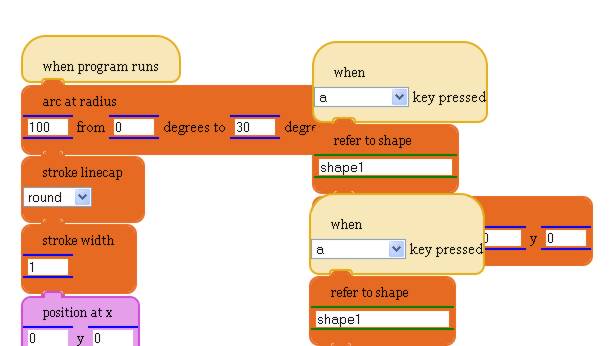
Waterbear, a new "Scratch- like" visual programming language made its debut at a JavaScript conference this week.

Waterbear is the brainchild of Dethe Elza who presented it at the JSConf held in Portland on 2-3 May 2011. Inspired by Alan Kay's Squeak language and Semour Papert's Mindstorms he hope it will introduce programming concepts to learners, including children. His choice of the name Waterbear is because he want it to be an extremely robust language - like the microscopic animals that are found in extreme environments over he entire world.

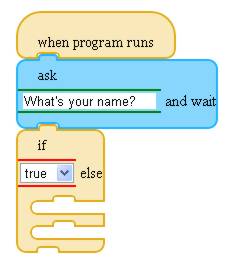
This news item is a lot easier to understand if you already know about the Scratch programming language. Scratch is a visual language aimed at beginners and children in particular. You don't write a program in Scratch you assemble it by dragging and dropping blocks representing programming constructs onto a design surface. You still have to set values via parameter slots within the blocks but the difficult task of creating the program's flow of control is reduced to clicking blocks together.

waterbear2


Scratch isn't the only language to take the visual approach. The Android App Inventor uses the same idea to let you create mobile phone apps. One of the first such visual systems was the robot programming language packaged with the Lego Mindstorms kits. Now we have something a little different. Waterbear is a visual programming language that generates JavaScript. Scratch just creates the program and you run it in the Scratch environment but Waterbear is a compiler or translator from the visual language to JavaScript. It actually doesn't create pure JavaScript as it uses the jQuery library fairly heavily.

waterbear1

As the whole thing runs in a web page the JavaScript it creates already has an environment to run in and you can create and test a program without having to install anything additional - this is also one of the first fully web hosted development systems. Not only is it web hosted it is, of course, written in HTML5/CSS3 and Javascript. You can download the code or join in the project at github. You can also try the whole thing out at http://waterbearlang.com/ but be warned it is a very early alpha.

As well as a really interesting educational tool you can't help but speculate on its use as a real HTML5 based app. Maybe this is the tool we are looking for!?


Tuesday, December 21, 2010

Google launches Latin translation tool

http://www.telegraph.co.uk/technology/google/8034196/Google-launches-Latin-translation-tool.html


Google has added Latin to its list of languages on Google Translate
By Claudine Beaumont, Technology Editor 11:07AM BST 30 Sep 2010

Google Translate supports more than 50 languages, including minority languages such as Welsh and Haitian Creole, and the addition of Latin is sure to please scholars and traditionalists.

In a blog post, written entirely in Latin, Jakob Uszkoreit, a senior engineer at Google, said that Latin was far from a “dead language”.

“There are many Latin language learners,” he wrote. “Over 100,000 American students take the National Latin Exam every year and many more learn Latin all of the world. And there is a wealth of information originally written in it.”

He said that while Google recognised that the Latin translation tool would rarely be used to decipher emails or captions on YouTube videos, it would enable web users to read many of the crucially important philosophical and scientific texts originally written in this language.

“There are tens of thousands of scanned books written in Latin on Google Books, and many more contain Latin quotes and proverbs,” he wrote.

Tuesday, September 28, 2010

UK Teenage Slang

From http://news.bbc.co.uk/2/hi/uk_news/magazine/8388545.stm

Paul Kerswill, professor of sociolinguistics at Lancaster University, is studying street language in London. He says an entirely new dialect is emerging.

"Young people are growing up with a new form of composite language. It's a bit cockney, a bit West Indian, a bit West African, with some Bangladeshi and Kuwaiti - and it seems to be replacing traditional cockney."

From http://news.bbc.co.uk/2/hi/school_report/8551273.stm

...To illustrate the differences we gave the same phrase to children in different parts of the country and ask how they would say it in their own slang.

The phrase we chose was: "John's girlfriend is really pretty. But she got mad with him the other day because he wanted to hang out with his friends rather than take her to the cinema. She got really angry and stormed off. It was very funny."

Now see how the phrase was regurgitated in the local vernacular in five schools.

--
Bishopston Comprehensive School, Swansea, Wales

"John's missus is flat out bangin'. But she was tampin' the other day 'cause he bombed her out for the boys instead of going to the cinema. She... started mouthing. It was hilarious."

--
Holy Family Catholic School, Keighley, West Yorkshire

"Jonny's bird is proper fit and she got in a right beef the other day cos he'd rather chill with his mates than go to the cinema. She got stressed and did one. It was quality haha."

--
Cardinal Newman High School, Bellshill, Lanarkshire

"John's burd is well stunnin'. She wis pure mental wae 'um the other day cos he wantit tae hing aboot wi 'is pals 'n no take hur tae the Showcase. She took a hissy 'n bolted. It wis well funny."

--
Phoenix High School, Shepherds Bush, west London

"John's chick is proper buff but she switched on her man the other day 'cos he wanted to jam with his bred'rins instead of taking her out to the cinema. She was proper vexed and dust out. It was bare jokes."

--
St Cecilia's College, Londonderry, Northern Ireland

"John's girlfriend is pure stunnin'. But she was ragin' cos he dogged her out of it to got to the pictures with his muckers. She pure went into one and booted. It was some craic."

--
Rodborough School, Godalming, Surrey

"John's girlfriend is well fit. But... he wanna chill out wid his m8s rather than take her to the film. She got like well lairy and she legged it. LOL."

SLANG WORDS

wasteman (London) - idiot, fool

bewt or pearla (Wales) - fantastic or beautiful

sick (London and south east) - very good

tidy or sound (Wales) - good

craic (Northern Ireland) - good fun

buff or peng (London and south east) - very attractive

bangin' or mint or lush (Wales) - very good looking

hissy (Scotland) - angry or losing temper

owned (London and south east) - beaten up or made a fool of
beef (Yorkshire) - grudge or argument

Other examples from http://news.bbc.co.uk/2/hi/uk_news/magazine/8388545.stm

Nang/nanging - excellent
Hard, greezy - excellent
Allow it - let it go, stop
What's good - hello
I'm ghost - goodbye
Chung, peng - attractive
Long - boring
Bare - lots of, very
Sik - cool
Moist or dry - awful, terrible

Thursday, September 16, 2010

Currently the Most Annoying Meme: "I know, right?"

***

"I know, right?"

http://www.urbandictionary.com/define.php?term=i+know%2C+right%3F

This phrase has been whittling me down to my last ganglion and I finally had to search and confirm that I'm not the only one to notice. That's how out of the loop I am. I mentioned it to some friends the other day who looked at me with slight concern, and I suspect that they are not likely around the same generation or demographic of idiots as myself.

For those of you who embrace this phrase, please correct your reflex before it spreads any further. For me, it renders the user into a caricature that falls somewhere between the McKenzie brothers' "Great day, eh?" and Jeff Spicoli's "I'm so wasted!", yet the intention seems to carry an attempt to associate with a more elite crowd who believes themselves to be in the know. 'Who knew?' I guess that would be the 'hipster'. That's who knows. Knows to say 'who knew'. As Ken Nordine describes the atheist who publicly humiliates a small town preacher with his 'sparkling wit and his shallow understanding'.

 But in the case of adorning oneself with a plumage of memes, there is only the pretense of wit to camouflage the complete absence of originality or processing. I doubt many of the kids who embrace 'sagging' were deliberately seeking to associate themselves with criminals.

Maybe it's a little worse in the South, where people sometimes overcompensate by dissociating themselves, neutralizing their southern accents or even taking on regional affectations. But, I can recall a blatant instance of such dissociation between two coworkers who were both from Chicago.

I believe the phrase to be akin to "Well, that's right", a slightly lesser offense often committed by NPR reporters as the host introduces the story and the correspondent picks up with the details with a tone of self-assured authority. It is here that I believe we begin to approach one popular habitat of the meme pond.

But, there are many, many such environments that I have thought would likely come to screeching halts should someone impose penalties or threats of revoking their language licenses should they commit certain memetic offenses. In fact, I sent myself a brief email back around 2007 that I believe is an update from previous years, noting specific phrases that I wish to flag, daring the meme-ridden, jargon-saddled appropriators to restrain themselves. I have found that overuse of 'frankly' and 'caveat' will bore into flesh at an alarming rate. Surely, we all know someone who clings desperately to 'at the end of the day' like a hyena gnawing on a picked over carcass.

And describing anyything as 'delicious' has gotten completely out of hand, especially as a way of projecting one's appreciation for intellectual pursuits. It makes me feel like I'm listening to a displaced obscene phone caller.

Few these days are so brazen as to say 'Thus, or 'thusly', but why hold back? Newscasters and politicians being so incestuous, make use of the same limited arsenal which has included 'transparency', 'an historic', and 'holed up in a...(mosque, the office, the public restroom stall, etc.). I feel redeemed to verify a few of these irksome phrases as I write these thoughts. When speaking of India for example, a reporter will often replace the next reference to India with 'that country'.

'As for Iran, Mr. Powell said he doesn't think "the stars are lining up" for an attack on that country's known or suspected nuclear sites.'
(Extracted from an article in the Washington Times.)

I understand and appreciate variety in language, but how about a little variety in treatment? Because these people use this same damn convention every time and after a while of listening, I feel like I'm in the checkout line at the grocery store. Affirmative, I found everything I need.

Regarding 'an historic', the first link below states that as of 2008, 'an historic' is used by 30% of online writers compared to 'a historic', and that while 'an historic' is less common, both are correct.

The second link states that the 'question highlights a difference between American and British usage--though even British usage is moving away from using an in such phrases...'

Oh, I see. Trying to sound British, who also also refer to 'an regular guy'. Maybe this explains why 'an historic' strikes me more as needing to distinguish oneself or lunging for a heightened sense of importance. I know I heard George W. do it at least once. Anyone who has ever been accused of being 'a idiot' knows my frustration. Like mispronouncing 'especially' as 'ekspecially', while somehow gaining momentum as being an improvement upon language.

The second link offers great reference:

In Sleeping Dogs Don't Lay,* Richard Lederer and Richard Dowis are quite dogmatic about whether or not one should use an before such words as historic and historical:

an historic (never)
"This is an historic occasion," intoned Senator Pfogbottom.

"I don't care to listen to this windbag," said the cynical reporter. "I think I'll go to McDonald's for an hamburger."

. . . When the aitch (h) is silent, as in honor and hour, use the article an. When the aitch is pronounced, as in house, hamburger, history, and historical, use the article a. (33)

'A/an historic, usage'
http://www.betterwritingskills.com/tip-w005.html

http://grammartips.homestead.com/historical.html

'Holed up' - this one is worth reading.
http://www.urbandictionary.com/define.php?term=holed%20up

I realize that I am likely far behind the curve in my listing of memes. Those of you lobbing some of this crap over from the 'left coast', just simmer down. Yours will get to us eventually.

Let's close with a demonstration of how to dress up the crack whore of trite pleasantries with something that makes the vector feel that they are doing their part. Must I stumble through the cumbersome, 'Have a bless-ed day' or can I count on readers to receive a slightly toned down exchange?

With a little cooperation and tolerance, I propose that we might blend the oil and water of meme pools THUSLY:

'Have a blessed one.'

'I know, right?'

***

Designated meme receptical in list form:


100% - Might as well just shoot a blast of jizz when saying this. Like an ego cannon. 

Does that makes sense? - Some people feel the need to punctuate everything they say with 'does that make sense? in order to enslave the listener and make them their child. As soon as they establish the pattern in their speech, I stop responding and I might stop listening altogether. That makes sense to me.

Living my best life - I see this appearing everywhere on social media, like any of these phrases that get appropriated by the entire world, it becomes meaningless and pretentious. It's the update to 'Live Laugh Love' or 'Work hard, play harder', one of those platitudes you see plastered up on a wall over the couch when someone is trying to short sale their shitty townhouse. Urban dictionary recognizes how annoying it is.  Here's a song to put it in perspective from Snoop Dog and some other homies I don't recognize because I'm an old, out of touch honky https://youtu.be/QFFdSR6U_kc.

it's been a minute - sometimes a minute feels like an eternity, especially around those who are desperate enough to sound clever at the expense of being original.

epic - maybe this one's on it's way out, but it still sucks.

no worries - more hipster, smugness attempting to sound more sophisticated, worldly, in control, calm and cool, all the things hipsters wish to project.

I really enjoy checking urban dictionary for these phrases - helps me know I'm not alone - see comment 11:

"In USA, a flippant expression, almost always spoken by people who are insecure, as a way to quickly both end the conversation, and demean the other person by making it seem as though they were worried, when they were not. A top-down mentality, to belittle someone, from people of vast insensitivity. Should be banished immediately."

hot mess - enough of this, please. You're old and dry.

but, I digress - While you're at it, why don't you do us all a favor and drop dead


a certain je ne sais quoi, and quid pro quo can both take a hike

boo-yah - thank God, this seems to have fallen out of vogue, but I'll bet it's lurking somewhere

golden (as in "you're golden" i.e. situated or optimal condition) - trust fund hippies love this one

all the trimmings (this is really just an idiom, but it gets on my nerves, and not just at Thanksgiving)

uber - put it back in your man purse, roll up a pants leg and courier yourself elsewhere

proverbial - Not that I can think of a better substitute, but it's overused, and typically those who use it wear it like a badge. Better to just not use it at all. Combined with the quote marks in the air, we have a complete snap shot. Probably the same person who would dish out 'anywho' a lot and think they are funny, hip, and original.

snarky -  the word itself is almost self referencing. Apparently a combination of 'snide' + 'remark' =  snark, which puts the word somewhere on the same level as 'shart'. I must admit, for a minute there I was almost convinced snark was a real word. I concluded snarkasm, snarkastic and snarkaholic on my own, but turns out I'm not the first.

girls night out / man-cave:  these two go great together. The willingness to relegate ourselves to the role poles in the most stereotypical ways. How can we live in such a politically correct society that is so fast to adopt these kinds of terms for gender-based tendencies? Men can have a home office, and so can women. Can't women and men can both go out with their friends without dubbing it some kind of title? And, shouldn't it be 'Woman's night out'? If a guy decided to start labeling his wife's social outings as 'Girl's Night Out', it wouldn't fly, kind of like the monopoly blacks maintain on the 'N' word. Although I hear that license has been extended to people of all races under a certain age, along with the right to posting selfies. Is the logic that they don't know any better, thereby rendering the act innocuous, or is it that they are so in the know and qualified to handle these dangerous goods? As for the aforementioned terms, this is how couples identify their need to preserve their identities without feeling threatened when they aren't spending time together.

endoplasmic reticulum - just kidding

best (insert anything here) ever - see snarky, and see what I mean. Conspicuous in the Awesome movement

have a great day - especially when used in voice messaging. Some people seem to think this conveys an air of professional courtesy, and I hear it a lot. Just send flowers if you care so much. Have a nice day has been lampooned for decades, so how has have a great day made it this far? By the time I've waited through enough rings to reach a voice message, I don't want to hear long, obligatory instructions about what I'm supposed to do, unless there's another number I can try. But, then, to finish off with 'have a great day'? I'm really surprised at who complies to this convention. I suspect it's control freaks who cast the wide safety net of have a great day. I even encountered one person who went above and beyond to say 'make it a great day'. When I hear 'have a great day' in an answering message, if I know the person, I sometimes let them know in my message that I am, in fact, having a great day, and this is the same line of thinking that caused me to leave Facebook, for fear of alienating a lot of people by mocking their projections of home dining choices, curling up on the couch with coffee and a book, or deep lyric quotes.  Upon reflection, 'have a good one' or 'have a blessed day' are almost from another planet, or at least from another socioeconomic status. Ahhh!

Bless you - say this to me once, and I'll go along with it. But, say it with each sneeze and I might get claustrophobic and start swinging. Relax, demons will not enter my body if I sneeze and noone is around to say 'Bless you'. If I'm wrong, this is nothing that can't be solved with a phone app and a microchip implanted into our skulls.

Shoot me an email -  I had no idea that email was such an action sport.

Made/makes me smile - an awkward attempt at sentimentality, but ick, the phrase gets passed around like a nasty chapstick. In response to a joke, it can be a little smug. Smile? Oh, well, I was hoping you'd piss your pants.

Oh, and... I'm seeing this used a lot in job postings. Rather than the usual, long list of requirements, recruiters are trying to sound conversational or spontaneous, I guess, and maybe adorn snark fashion as though they have a personality? Either the recruiter is challenging the would-be candidate to possess all of the above qualifications to join the ranks of their elite company, or they are trying to sell the job by making it sound generous, as though saying 'but wait, there's more' like they're selling a Ronco product. It typically reads like: 'Must be fabulous. Oh, and did I mention we're fabulous?' When I see such a post, I get the impression that the company culture consists of vacuous reality tv consumers who spend too much time pecking at their mobile device and L'ing-O-L on Facebook.

anywho - It's as though everyone who would otherwise quote Monty Python was disemboweled and then re-stuffed with Jim Carrey.

'try and' vs 'try to' - Maybe this is more noticeable in writing than in speech, and I found reference stating that 'try and' is an idiom/colloquialism whereas 'try to' is formal and works in any context (for those who learned to read and write?).

For me, 'try and' instantly casts the speaker and especially the would-be writer into the same herd of dipshits who pronounce 'something' as 'suh-ehn'.

Mechanically, the problem is that 'try and' separates 'try' from the stated intention, thereby setting up two intentions, and also suggests a guaranteed outcome while casting the object of 'try' into oblivion. For example, to say 'I will try to remember' links effort - try - to the infinitive form of the verb - to remember.   'I will try and remember' suggests that 'I will try' and 'I will remember'. Wait, try what? Did someone put out a Whitman's sampler in front of you as a memory enhancer? 'Try to' guides effort towards the stated target - 'to remember'.

Let's concoct a context. Someone asks when you last ate pizza. You respond, "I'm trying to remember" as you are thinking. Then, they ask you to send an email when you remember, and you say "I'll try to remember".

If your over-eager, braggadocious street phrase toolbox contains only 'try and...', you'll be wallowing in your present tense failure, confessing "I'm trying and not remembering" or more pathetically "I'm trying...", so ashamed you can't complete the sentence. Just fast forward to your inevitable memory failure in the future tense so you can employ that one-trick pony "I'll try and remember". You dumb ass.

find funny - more an idiom, but at least I must call to question some pretense in the insistance upon 'I find that funny...I don't find that funny'. These days, I guess 'that's funny' is just too dogmatic for our sensitive society, or maybe the slightly apologetic 'I think that's funny' is just too Casual Friday. We have to put on our little owl glasses and 'find it funny' or 'find it offensive'. When I pulled back the drapes, there it was. I found it. And then, I LOL'd.

lovely - unless she's British, any woman who says 'lovely' is probably reading way too many pulp romance novels. 

Sarcastic usage, though somewhat unoriginal, is reasonably appreciated: 

OBGYN: "Miss Johnson, I'm afraid you have a yeast infection." 
Miss Johnson: "Oh, lovely."

...as opposed to:
OBGYN: "Miss Johnson, you have a lovely yeast infection." 
Miss Johnson: "Try and get rid of it. Anywho..."


Corporate memes

utilize - Number one on my list of annoying corporate memes. Unless you're discussing plant food, just say 'use', or I'll utilize a club on the back of your skull. Here's some reference that backs up my point in a way that I appreciate. 

delight the customer - Should I utilize my hand with some lotion and an old tube sock? I'm pretty sure that would be a great utilizer experience. I know would be delighted.

lean into - Maybe it's an effective analogy, but it's leaning into my nerves.

at the end of the day - "Oh! You're so in control! You determiner of everyone's fate."

level set - ...deez nutz on your chin.

move the needle - The only needle I see you moving is your ding-a-ling with a pair of tweezers.

pivot - I can't wait for society to pivot to something less annoying. Until then, all you jargonauts can sit and pivot on a bicycle without a seat.

caveat - Just when I'm feeling enthused, the speaker announces there's a caveat. I can live with whatever caveat, but if you run 'caveat' up your flagpole every time we talk, I'll start carrying a confetti cannon. 

having said that -  See caveat. Allows the speaker to waste more of the listener's time.

in a timely manner - If I hear this one more time, my anus is going pucker into a black hole and vacuum up all matter in the universe. Not all at once, but certainly in a timely manner. Try 'promptly' or 'immediately'.

fair enough - Middle management loves this one, especially when a direct report bucks their micromanagement by being right.

nonetheless
 (a legitimate expression, but in the hands of the wrong idiot, it becomes a weapon). 
From the same people who say "the proverbial..." while gesturing quote marks.

frankly - I appreciate the candor, but anyone who says 'frankly' with a straight face probably has a mustache, tennis shoes, and a red tie with a big yellow M.
Frankly, I would like fries with that.

Let's dive in - Every wanna-be siren begins their spiel with this same phrase, along with 'You see...' before every explanation. Check their LinkedIn profile to cringe at their 'Servant-leader' or 'Storyteller' headline self-aggrandizement. Tell YOUR OWN STORY in YOUR OWN WORDS, fuckers. Hopefully, they all dive into quicksand and are never heard from again. 

At scale - God never told Adam and Eve, "Be fruitful, at scale." Nor did he tell Eve to utilize Adam's seed. 


Jargon I'm guilty of using
After searching for some comparisons, here's an extraction of buzzwords:

Bandwidth - beaten into me as a designer

Boil the ocean - because I'm naive, idealistic, and damn determined to do things the hard way.

Break down silos - my favorite way to ruin surprises in an enterprise environment

Drill down - I learned this one from one of my favorite devs. It's what to do when I'm not breaking down silos.

Herding cats - i.e. dealing with Legal. It's the reason to run an HOA with only a board of three.

Hot-desking - because I hate this practice enough to know it by name.

In the weeds - because I grew up working in restaurants.

Low-hanging fruit - because you can't boil the ocean, but you can steam your underwear. 

Move the goalposts - When I was 18, I voted as Democrat to support education and stay out of war. 
Back when liberals were peaceful. And giant, pickle-nosed men who dressed as women and walked around at the mall were known as transvestites.

Pain point - string enough of these together and you're ready to boil the ocean or hop for low-hanging fruit.

Put out a fire - I don't say this, but I accept it's usually why my boss isn't available.
I appreciate the implied heroism because it means they, too, are miserable and want to be admired.

Reinvent the wheel - because I hope to bask in the glory of originality.

Run the numbers - because I'll trust someone else can do that, and then guess if I should believe them.


Gesture Memes

I've opened a can of worms here.

The act of snorting when laughing -  I realize that most people might regard this phenomenon as an involuntary act or parasympathetic accompaniment, and at first glance it's perhaps endearing and comical. However, I recently encountered one who snorts while laughing with abandon and later spoke of it openly and with pride, justifying it as a sign of their intellect. 

I have witnessed the same unapologetic snortering before, and I can only conclude that either they truly cannot control their snorting, that their parents might have told them it's a sign of intelligence, OR that snorting while laughing is a learned affectation that they choose to embrace and flaunt to deliberately project eccentricity. 

I immediately think of the Tappet brothers from Car Talk on NPR, who are both funny and smart snort-laughers.  I don't think I've ever heard either of them say 'I know, right', but it's been a while since I listened. 

Maybe I'm being unfair, but my tendency is to associate it with people who want not only to be perceived as intelligent but possibly as a chip on the shoulder, as though to say, 'I snort when I laugh and I don't care what you think about me' or 'If you really love me, you'll continue to accept me even though I snort when I laugh'. 

I'm not saying that people can't accidentally snort when laughing, but when it's chronic, I suspect that someone either had a competitive sibling rivalry or that their parents passed it down as a family party trick. Much like being locked in a car on a road trip with someone's smelly feet. When it morphs into a fart-laugh, it's time to break out Frankly.

The Ernie laugh - Cover your front teeth, hunch your shoulders, bobble your head, and march in circles while continually coughing up fur balls.

The fist bump - I've waxed on about the fist bump in another entry.

Chin pose - "You know, to be ahness wichoo" - This one made a mark on me when a guy delivered my washing machine, and now, to be ahness wichoo, I can't stop using it. I'm including this one under gestures because the expression goes best with the chin pose.


Thursday, June 3, 2010

British Dialect or Speech Impediment? Rhotacism

I've heard the Elmer Fudd effect from many British speakers and not just from the BBC's Jonathan Ross - also Terry Jones of the Monty Python troup, Dave Murray of Iron Maiden, Frank Muir on the BBC's game show, 'My Word!, and several other BBC reporters.

Here's a great example:
http://www.chinadaily.com.cn/video/2011-12/14/content_14263204.htm

It would seem more likely that the BBC would legitimize a dialect than they would hire someone with an impediment. But that didn't impede Barbara Walter's career.

This effect is apparently called 'Rhotacism'.

I found a forum with the heading of "http://ask.metafilter.com/67058/Wabbits">Wabbits", which delves into this effect prevalent amongst certain Britains.
http://ask.metafilter.com/67058/Wabbits

The question is whether we are hearing a true dialect, a speech impediment, or perhaps a dialect that developed around someone of influence who had a speech impediment. Certainly the impediment is corrected when it appears at an early age here in the States, as are crooked teeth. So what's the scoop?

No greater homage to the phenomenon than the scene in Monty Python's Life of Brian:
http://www.youtube.com/watch?v=2K8_jgiNqUc


Comments from the Wabbit Weblog:

The wikipedia page for Jonathan Ross refers to "a common dialectal variant of English common in the UK called the labiodental approximate. This pronunciation has increased in usage over the past 30 years and is mainly associated with speakers in the South West of England, although Ross is actually a Londoner."

Welsh people do this quite a bit. I spent a year in Wales, and I never got tired of my coworker's breathey "Wheally, Bill?" when she meant "Really, Bill?"
Terry Jones is the Pythonite who does it, and if you listen closely to Catherine Zeta-Jones, she slips her r's for w's when she's excited. On the Chicago soundtrack, listen for "My sister Vewonica and I..."

There's tons of good examples of this trend. An accessible one is found in the Welsh rap group Goldie Lookin' Chain's "Guns Don't Kill People, Rappers Do." The refrain becomes "wappers do!"

It's totally South Wales, like Cardiff/Newport. And you can hear it in some folks up through Powys, but it fades pretty rapidly. For example, lots of people have the r-to-w in Llandrindod and Builth, but almost no one does in Rhayader. And not many in Brecon do, despite Brecon being further south. Brecon and Rhayader have a relatively high number of native Welsh speakers, where the trilled r prevails.

People from South Wales don't trill the r, but they still have the heavy aspirant quality associated with a Welsh accent. It's a "breathy" r that ends up sounding like a w.