Tuesday, August 14, 2012

NASA scientists test 4,500mph hypersonic jet

http://www.dailymail.co.uk/sciencetech/article-2187520/London-New-York-hour-Radical-new-aircraft-reach-Mach-6-set-tested.html

  • Scramjet engine can accelerate craft to over Mach 6
  • Could dramatically slash journey times by travelling at five times the speed of sound
By Daily Mail Reporter

|
It looks like something you’d expect to see launch from Tracy Island.
But this Thunderbirds-style aircraft could be the future of long-haul flights.
The hypersonic X-51A WaveRider belongs to the US military and uses a revolutionary ‘scramjet’ engine to reach 4,500mph within seconds.
London to New York in Less than an hour: The X-51A Waverider is designed to ride on its own shockwave, accelerating to about Mach 6
The flight of the waverider
Arduous journeys for holidaymakers could be a thing of the past if the technology takes off. A trip across the Atlantic from London to New York would take the plane just one hour, travelling at five times the speed of sound. 

Today the cutting-edge craft will be dropped from a B52 bomber over the Pacific Ocean in its latest test.

It will be flown from Edwards Air Force Base in the Mojave Desert in California, attached to the bomber’s wing.

HOW IT WORKS

Scramjets are 'airbreathing' aircraft because rather than carrying both fuel and the oxygen needed to provide acceleration, they carry only hydrogen fuel and 'pull' the oxygen needed to burn it from the atmosphere.

Air is forced into the front of the engine and as hydrogen is injected into the airstream, the gases are compressed causing the temperature to rise and ignition to occur.

This generates huge amounts of thrust and enables the jet to travel at speeds far in excess of the 1,350mph top speed of Concorde.
The jet will then be dropped from almost 50,000ft near the Point Mugu promontory. A rocket booster will ignite and speed it up to about Mach 4.5 and, if all goes well, the aircraft’s engine will take over from there, pushing the speed to more than Mach 6 and lifting the craft to 70,000ft.

The mission will last 300 seconds – the longest the craft has ever flown to date. After the historic test, the plane will crash into the sea, and there are no plans to recover it. 

Hypersonic flight – which relates to speeds of more than five times the speed of sound – is seen as the next step for aircraft. ‘Attaining sustained hypersonic flight is like going from propeller-driven aircraft to jet aircraft,’ Robert Mercier, deputy for technology in the high speed systems division at the Air Force Research Laboratory in Ohio told the Los Angeles Times.

‘Since the Wright brothers, we have examined how to make aircraft better and faster. Hypersonic flight is one of those areas that is a potential frontier for aeronautics. I believe we’re standing in the door waiting to go into that arena.’

The project is being funded by Nasa and the Pentagon, which hope it can be used for military stealth aircraft and new weapons.

The WaveRider programme is estimated to cost £89million, according to Globalsecurity.org, a website for military policy research. It has had a mixed history, with previous tests being aborted after the engine stalled.

Currently the fastest passenger plane in the world is the Cessna Citation X, which has a top speed of 700mph or Mach 0.9, although it takes only seven passengers.
In its wake is the Falcon 7X at 685mph and the Gulfstream G550, which is capable of 675mph. The experimental craft will be tested strapped to the wing of a B-52 bomber. Once released, it's radical scramjet engines will be fired, hopefully accelerating the craft up to Mach 6, over 2,000 metres per second.
The experimental craft will be tested strapped to the wing of a B-52 bomber. Once released, it's radical scramjet engines will be fired, hopefully accelerating the craft up to Mach 6, over 2,000 metres per second.
The X-51A Waverider on the wing of a B-52 Stratofortress. A previous test was the longest supersonic combustion ramjet-powered hypersonic flight to date.

Mach is a measure of the ratio of the velocity of an object, in this case a plane, to the velocity of sound, which equals Mach 1, or 761.2 miles per hour.
 
Any plane that flies past the speed of sound creates a sonic boom, which often results in a major noise disturbance over close-by areas. Before its 2003 retirement, Concorde was long the shuttle of choice for executives eager to spend as little time as possible in the air and unafraid to shell out thousands for a 3.5-hour transatlantic flight. 

An attempt to launch a hypersonic flight in August last year failed when the soaring heat caused the craft’s surface to peel and the experiment ended prematurely.
The Pentagon’s research arm calls hypersonic flight ‘the new stealth’ for its promise of evading and outrunning enemy fire. The effort to develop hypersonic engines is necessary because they can propel vehicles at a velocity that cannot be achieved from traditional turbine-powered jet engines. 

Experts believe hypersonic missiles are the best way to hit a target in an hour or less. The only vehicle that the military currently has in its inventory with that kind of capability is the massive, nuclear-tipped intercontinental ballistic missile.
The scramjet engine is designed to ride on its own shockwave, and should see the test craft accelerate to about Mach 6.

Sunday, August 12, 2012

Tom Kenny stand up (voice of Sponge Bob)

I've been looking for this forever - saw him in the 90s on A&E Evening at the Improv - hilarious.

More videos on this link:

http://www.cc.com/video-clips/8rit53/stand-up-tom-kenny--cartoon-universe


--

http://comedians.jokes.com/tom-kenny/videos/tom-kenny---moving/

http://comedians.jokes.com/tom-kenny/videos/tom-kenny---cartoon-universe/

http://comedians.jokes.com/tom-kenny/videos/tom-kenny---high-speed-tank-chase

http://comedians.jokes.com/tom-kenny/videos/tom-kenny---titanic/

http://comedians.jokes.com/tom-kenny/videos/tom-kenny---miss-teen-usa

http://comedians.jokes.com/tom-kenny/videos/tom-kenny---aftershocks

Here's an excerpt from an interview I found:

We recently had the pleasure of talking with Mr. Kenny about all this, how he doesn’t miss stand up, and how he really doesn’t care if you don’t know who he is.

When I was looking at your resume, I was blown away because you do so much stuff.

Yeah, I’m pretty ubiquitous (Laughs). Well I guess secretly ubiquitous. I’m like all over the place but under the radar at the same time, which is kind of a weird occupation in bold description.

How did you transition from film and stand-up to voiceover? You know, Shakes The Clown is kind of a cult classic and you were on the sketch comedy shows and everything.

Well it’s funny. It wasn’t so much a transition as, you know, you’re just doing a whole bunch of stuff. And I started doing standup as a standup comedian and sketch performer and wound up being cast in Shakes The Clown because I knew Bob Goldthwait really well from when we were kids and I was working with Julie Brown on stuff. And he was just calling in favors to his friends. So at the time I was doing Shakes The Clown, I was also at that time, a writer on the America’s Funniest Home Videos spinoff America’s Funniest People while Shakes was filming. And I was also doing standup. And I wanted to be doing voiceover but I hadn’t quite broken into that very much yet. It was the toughest nut for me to crack and the one that I most wanted to do. But yeah, the short answer is it wasn’t so much a transition as you’re just kinda doing a whole bunch of things at the same time. You just gotta take whatever work comes along and dance with whatever girl wants to dance with you and feeling glad to be gainfully employed at any one place let alone a couple of different places and having fun learning how to do stuff. Learning how to write on a show and that was enough to make me realize that that wasn’t a direction I wanted to go in (Laughs). And you know, just trying to build a career and decide what your career’s gonna be.

Are you still doing stand-up?
No, not for many years. I don’t think I’ve done it since sometime in the 90′s.

Is it tough to let that go?
For some people I think it would be tough to let it go but for me it was incredibly easy (Laughs). It’s amazingly easy. I felt like I’d done it and I knew how to do it and it was never my first love. And I had to come of age during the 80′s comedy boom and say “wow, I think I can do that. And I figured out how to do it. But I wasn’t as passionate about it as I think you need to be. Like some guys, they have to go on stage 4 or 5 times a week or they get itchy palms. I was totally lacking that gene. It was starting to not be as fun for me and I think I was starting to realize that since I didn’t have that requisite passion and love for it that there was only so far you can be able to go with it, if you don’t love it. You know what I mean? If it’s not your passion, you get a feeling after a while, cause it’s not what you love. You can figure it out. And I had fun doing it; I got to go to a lot of places and meet a lot of people and make 100% of my living as a stand-up comedian instead of working in a Dilbert-type cubicle (laughs) but I felt like I was ready to transition into something else. And when the voiceover thing started happening, it was an easy door to walk through for me. I still don’t feel like I was leaving anything behind, you know? If I had to walk away from voiceover I would feel like I was leaving something I loved behind. With standup I felt like I had this skillset I accrued from doing this a bazillion times and I think I can put that in this other arena and have a different kind of job that maybe suits me better. But then there’s like Patton (Oswalt) and you know, people I know like Steven Wright, Robin Williams, Bobcat Goldthwait. They love doing standup. They love to pick up their sword and sally forth into battle, you know? And I was always lacking that gene.


Excerpts from Shakes the Clown


http://en.wikipedia.org/wiki/Tom_Kenny


Mars 360 panorama, plate tectonics

360 panorama:

http://www.photojpl.com/curiosity-landing-site-on-mars-first-hd-panorama-of-gale-crater/-/s4fkBPaSqJ/

UCLA scientist discovers plate tectonics on Mars

http://newsroom.ucla.edu/portal/ucla/ucla-scientist-discovers-plate-237303.aspx

View of central segment of Mars' Valles Marineris 

View of central segment of Mars' Valles Marineris, in which an older circular basin created by an impact is offset for about 93 miles (150 kilometers) by a fault.

(Credit: Image from Google Mars created by MOLA Science Team)
 
For years, many scientists had thought that plate tectonics existed nowhere in our solar system but on Earth. Now, a UCLA scientist has discovered that the geological phenomenon, which involves the movement of huge crustal plates beneath a planet's surface, also exists on Mars.
 
"Mars is at a primitive stage of plate tectonics. It gives us a glimpse of how the early Earth may have looked and may help us understand how plate tectonics began on Earth," said An Yin, a UCLA professor of Earth and space sciences and the sole author of the new research.
 
Yin made the discovery during his analysis of satellite images from THEMIS (Thermal Emission Imaging System), an instrument on board the Mars Odyssey spacecraft, and from the HIRISE (High Resolution Imaging Science Experiment) camera on NASA's Mars Reconnaissance Orbiter. He analyzed about 100 satellite images — approximately a dozen were revealing of plate tectonics.
 
Yin has conducted geologic research in the Himalayas and Tibet, where two of the Earth's seven major plates divide.
 
"When I studied the satellite images from Mars, many of the features looked very much like fault systems I have seen in the Himalayas and Tibet, and in California as well, including the geomorphology," said Yin, a planetary geologist.
 
For example, he saw a very smooth, flat side of a canyon wall, which can be generated only by a fault, and a steep cliff, comparable to cliffs in California's Death Valley, which also are generated by a fault. Mars has a linear volcanic zone, which Yin said is a typical product of plate tectonics.
 
"You don't see these features anywhere else on other planets in our solar system, other than Earth and Mars," said Yin, whose research is featured as the cover story in the August issue of the journal Lithosphere.
 
The surface of Mars contains the longest and deepest system of canyons in our solar system, known as Valles Marineris (Latin for Mariner Valleys and named for the Mariner 9 Mars orbiter of 1971–72, which discovered it). It is nearly 2,500 miles long — about nine times longer than the Earth's Grand Canyon. Scientists have wondered for four decades how it formed. Was it a big crack in Mars' shell that opened up?
 
"In the beginning, I did not expect plate tectonics, but the more I studied it, the more I realized Mars is so different from what other scientists anticipated," Yin said. "I saw that the idea that it is just a big crack that opened up is incorrect. It is really a plate boundary, with horizontal motion. That is kind of shocking, but the evidence is quite clear.
 
"The shell is broken and is moving horizontally over a long distance. It is very similar to the Earth's Dead Sea fault system, which has also opened up and is moving horizontally."
 
The two plates divided by Mars' Valles Marineris have moved approximately 93 miles horizontally relative to each other, Yin said. California's San Andreas Fault, which is over the intersection of two plates, has moved about twice as much — but the Earth is about twice the size of Mars, so Yin said they are comparable.
 
Yin, whose research is partly funded by the National Science Foundation, calls the two plates on Mars the Valles Marineris North and the Valles Marineris South.
 
"Earth has a very broken 'egg shell,' so its surface has many plates; Mars' is slightly broken and may be on the way to becoming very broken, except its pace is very slow due to its small size and, thus, less thermal energy to drive it," Yin said. "This may be the reason Mars has fewer plates than on Earth."
 
Mars has landslides, and Yin said a fault is shifting the landslides, moving them from their source.
 
Does Yin think there are Mars-quakes?
 
"I think so," he said. "I think the fault is probably still active, but not every day. It wakes up every once in a while, over a very long duration — perhaps every million years or more."
 
Yin is very confident in his findings, but mysteries remain, he said, including how far beneath the surface the plates are located.
 
"I don't quite understand why the plates are moving with such a large magnitude or what the rate of movement is; maybe Mars has a different form of plate tectonics," Yin said. "The rate is much slower than on Earth."
 
The Earth has a broken shell with seven major plates; pieces of the shell move, and one plate may move over another. Yin is doubtful that Mars has more than two plates.
 
"We have been able to identify only the two plates," he said. "For the other areas on Mars, I think the chances are very, very small. I don't see any other major crack."
 
Did the movement of Valles Marineris North and Valles Marineris South create the enormous canyons on Mars? What led to the creation of plate tectonics on Earth?
 
Yin, who will continue to study plate tectonics on Mars, will answer those questions in a follow-up paper that he also plans to publish in the journal Lithosphere.
 
 
UCLA is California's largest university, with an enrollment of nearly 38,000 undergraduate and graduate students. The UCLA College of Letters and Science and the university's 11 professional schools feature renowned faculty and offer 337 degree programs and majors. UCLA is a national and international leader in the breadth and quality of its academic, research, health care, cultural, continuing education and athletic programs. Six alumni and five faculty have been awarded the Nobel Prize.
 
For more news, visit the UCLA Newsroom and follow us on Twitter.

Friday, August 10, 2012

'Smart Fingertips' Pave Way for Virtual Sensations


http://news.sciencemag.org/sciencenow/2012/08/smart-fingertips-pave-way-for-vi.html?ref=hp

Imagine feeling like you’re lifting a 50-kilogram weight just by pulling at thin air. That’s just one of the possible applications of new "smart fingertips" created by a team of nanoengineers. The electronic fingers mold to the shape of the hand, and so far the researchers have shown that they can transmit electric signals to the skin. The team hopes to one day incorporate the devices into a smart glove that creates virtual sensations, fooling the brain into feeling everything from texture to temperature.

Scientists have already developed circuits that stimulate our sense of touch. Some are used in Braille readers that allow blind people to browse the Internet. The devices work by sending electric currents to receptors in the skin, which interpret them as real sensations. However, most of these circuits are built on flat, rigid surfaces that can’t bend, stretch, or fold, says Darren Lipomi, a nanoengineer at the University of California, San Diego, who was not involved in the new study.

Hoping to create circuits with the flexibility of skin, materials scientist John Rogers of the University of Illinois, Urbana-Champaign, and colleagues cut up nanometer-sized strips of silicon; implanted thin, wavy strips of gold to conduct electricity; and mounted the entire circuit in a stretchable, spider web-type mesh of polymer as a support. They then embedded the circuit-polyimide structure onto a hollow tube of silicone that had been fashioned in the shape of a finger. Just like turning a sock inside out, the researchers flipped the structure so that the circuit, which was once on the outside of the tube, was on the inside where it could touch a finger placed against it.

To test the electronic fingers, the researchers put them on and pressed flat objects, such as the top of their desks. The pressure created electric currents that were transferred to the skin, which the researchers felt as mild tingling. That’s a first step in creating electrical signals that could be sent to the fingers, which could virtually recreate sensations such as heat, pressure, and texture, the team reports online today in Nanotechnology.

The work is "a striking achievement," Lipomi says, who notes that the device could have lots of applications. "In a virtual world, a trainee could perform virtual surgery, in which the devices were used to trick the trainee’s brain into believing they were actually performing a delicate task."
Rogers says another application of the technology is to custom fit the "electronic skin" around entire organs, allowing doctors to remotely monitor changes in temperature and blood flow. Electronic skin could also restore sensation to people who have lost their natural skin, he says, such as burn victims or amputees.

Wednesday, August 1, 2012

Oculus Rift virtual reality headset gets Kickstarter cash

http://www.bbc.com/news/technology-19085967

Oculus Rift headset design A concept design for the virtual reality headset has proved popular on crowdfunding site Kickstarter
 
A virtual reality headset supported by major video game developers is the latest tech project to cause excitement on the crowd-funding site Kickstarter.
Oculus Rift secured its target of $250,000 (£160,200) within its first four hours of going live.
The kit promises gamers an "immersive experience" using a 640 by 800 pixel screen for each of the user's eyes.
One VR expert noted that previous efforts to build a consumer-targeted device had disappointed.
But Palmer Luckey, the founder of California-based Oculus, said he believed his team had overcome the problems that had caused others to struggle.

Kickstarted cash

Oculus Rift is the latest in a series of tech firms to secure funds via Kickstarter. Backers do not receive a stake in the companies, but may be offered goods or other incentives by project developers to encourage them to donate.

Payments are only triggered if a scheme hits its target within a set time limit. That was not a problem for the VR headset which had given itself 30 days, but achieved its goal in about four hours.
To date the most successful project in financial terms has been the Pebble Watch. Its e-paper display and smartphone connectivity helped it attract more than $10.2m.

Ouya - an Android-based video games console - is also proving a success with about $6.1m of pledges. But sceptics say it is too early to call such projects a triumph until the devices find their way into consumers' hands.

"Most consumer-mounted displays have a diagonal field of view of about 30 to 40 degrees - you see a really small image way off in the distance and it doesn't make you feel like you are there," he said.

"With the Oculus Rift you get a diagonal field of view of 110 degrees. That means you're not looking at a screen any more - you actually feel like you are inside of the world."

Sony's HMZ-T1 personal 3D viewer, by contrast, offers similar resolution screens but only a 45-degree horizontal viewing angle. It launched last year and sells for £800.

Big beasts
 
Mr Luckey's efforts have already convinced some of the PC games industry's leading figures who agreed to appear in a promotional video. They include:
  • John Carmack, creator of the Doom series and co-founder of Id Software
  • Gabe Newell, chief executive of Valve, the firm behind Half Life and Portal
  • Cliff Bleszinski, design director at Epic Games, the maker of the Unreal Engine that powers Batman: Arkham City and a wide range of other titles
Mr Carmack announced in May that his firm was developing a version of Doom 3 which would be compatible with head-mounted displays.
He told The Verge tech site at the time that he finally felt that VR technology was getting to the point that it could be viable at a reasonable price point.
Oculus Rift field-of-view The developers say their kit has a much wider field of view than rival systems on the market
 
Oculus said it would bundle Doom 3 with early versions of its headset that it was offering to anyone who pledged $300 or more to its development costs.

Mr Carmack tweeted that the Oculus Rift was "a wonderful advance in VR kit" following the announcement, but stressed he had no formal ties to the project.

Tracking glitches
 
Others have doubts: Brain Blau used to carry out university research into virtual reality software and hardware before joining the tech consultancy Gartner.

He recalled that VR systems were popular in video arcades in the late 1980s and 1990s. He said the tech had gone on to win orders from the military and others who used it in training systems, but efforts to develop a consumer-orientated version had repeatedly failed.

"Head-mounted displays gives users a fully immersive experience," he told the BBC.
"But it can be very disconcerting as you're not used to seeing with part of your vision blocked and the tracking does not always perfectly match the visuals.
Doom 3 screenshot The developer kit is being bundled with a version of Doom 3 designed to work on headsets
"People have been trying for the past 15 years to make one that works well. Today's computing engines have advanced, so it's possible that this could work, but I'm sceptical as the other systems I've used have required a conscious effort to suspend your disbelief."

Oculus Rift acknowledged that other VR headsets had suffered latency problems - the issue of graphics not perfectly tracking the user's head movements - but added that it had managed to minimise the problem by using high-density light-weight screens and taking advantage of price drops in the cost of motion sensors.

The firm said it intended to deliver the first of its developer kits before the end of the year, but did not specify when a final product was expected to come to market.

Brain imaging predicts intelligence

‘Global Brain Connectivity’ explains 10 percent of variance in individual intelligence
By Gerry Everding

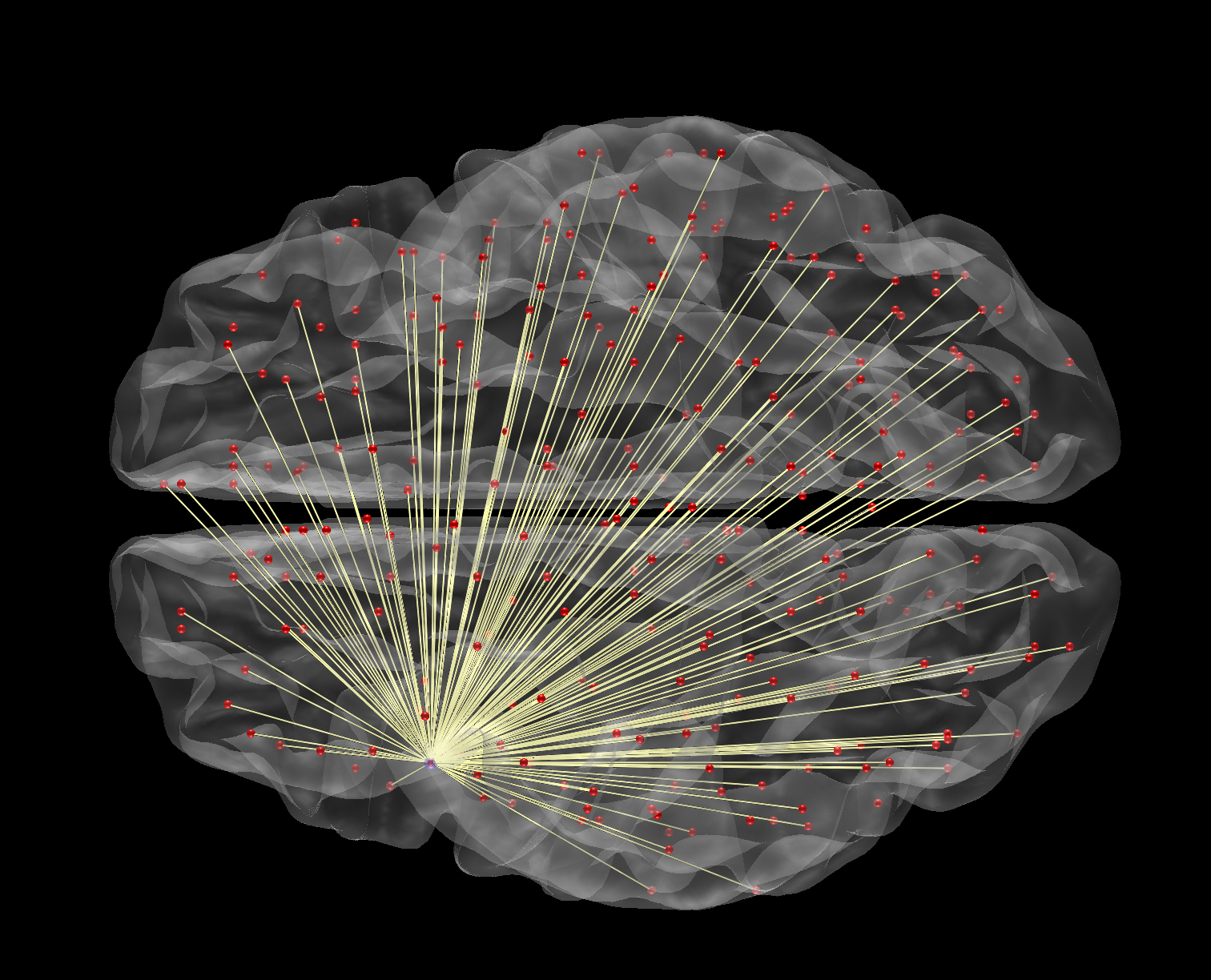
WUSTL Image / Michael Cole
New research suggests as much as 10 percent of individual variances in human intelligence can be predicted based on the strength of neural connections between the lateral prefrontal cortex and other regions of the brain. Download Hi-Rez.
When it comes to intelligence, what factors distinguish the brains of exceptionally smart humans from those of average humans?

As science has long suspected, overall brain size matters somewhat, accounting for about 6.7 percent of individual variation in intelligence. More recent research has pinpointed the brain’s lateral prefrontal cortex, a region just behind the temple, as a critical hub for high-level mental processing, with activity levels there predicting another 5 percent of variation in individual intelligence.

Now, new research from Washington University in St. Louis suggests that another 10 percent of individual differences in intelligence can be explained by the strength of neural pathways connecting the left lateral prefrontal cortex to the rest of the brain.

Published in the Journal of Neuroscience, the findings establish “global brain connectivity” as a new approach for understanding human intelligence.


Michael W. Cole
“Our research shows that connectivity with a particular part of the prefrontal cortex can predict how intelligent someone is,” suggests lead author Michael W. Cole, PhD, a postdoctoral research fellow in cognitive neuroscience at Washington University.

The study is the first to provide compelling evidence that neural connections between the lateral prefrontal cortex and the rest of the brain make a unique and powerful contribution to the cognitive processing underlying human intelligence, says Cole, whose research focuses on discovering the cognitive and neural mechanisms that make human behavior uniquely flexible and intelligent.

“This study suggests that part of what it means to be intelligent is having a lateral prefrontal cortex that does its job well; and part of what that means is that it can effectively communicate with the rest of the brain,” says study co-author Todd Braver, PhD, professor of psychology in Arts & Sciences and of neuroscience and radiology in the School of Medicine. Braver is a co-director of the Cognitive Control and Psychopathology Lab at Washington University, in which the research was conducted.

Todd Braver


One possible explanation of the findings, the research team suggests, is that the lateral prefrontal region is a “flexible hub” that uses its extensive brain-wide connectivity to monitor and influence other brain regions in a goal-directed manner.

“There is evidence that the lateral prefrontal cortex is the brain region that ‘remembers’ (maintains) the goals and instructions that help you keep doing what is needed when you’re working on a task,” Cole says. “So it makes sense that having this region communicating effectively with other regions (the ‘perceivers’ and ‘doers’ of the brain) would help you to accomplish tasks intelligently.”

While other regions of the brain make their own special contribution to cognitive processing, it is the lateral prefrontal cortex that helps coordinate these processes and maintain focus on the task at hand, in much the same way that the conductor of a symphony monitors and tweaks the real-time performance of an orchestra.

“We’re suggesting that the lateral prefrontal cortex functions like a feedback control system that is used often in engineering, that it helps implement cognitive control (which supports fluid intelligence), and that it doesn’t do this alone,” Cole says.

The findings are based on an analysis of functional magnetic resonance brain images captured as study participants rested passively and also when they were engaged in a series of mentally challenging tasks associated with fluid intelligence, such as indicating whether a currently displayed image was the same as one displayed three images ago.

Previous findings relating lateral prefrontal cortex activity to challenging task performance were supported. Connectivity was then assessed while participants rested, and their performance on additional tests of fluid intelligence and cognitive control collected outside the brain scanner was associated with the estimated connectivity.

Results indicate that levels of global brain connectivity with a part of the left lateral prefrontal cortex serve as a strong predictor of both fluid intelligence and cognitive control abilities.

Although much remains to be learned about how these neural connections contribute to fluid intelligence, new models of brain function suggested by this research could have important implications for the future understanding — and perhaps augmentation — of human intelligence.

The findings also may offer new avenues for understanding how breakdowns in global brain connectivity contribute to the profound cognitive control deficits seen in schizophrenia and other mental illnesses, Cole suggests.

Other co-authors include Tal Yarkoni, PhD, a postdoctoral fellow in the Department of Psychology and Neuroscience at the University of Colorado at Boulder; Grega Repovs, PhD, professor of psychology at the University of Ljubljana, Slovenia; and Alan Anticevic, an associate research scientist in psychiatry at Yale University School of Medicine.

Funding from the National Institute of Mental Health supported the study (National Institutes of Health grants MH66088, NR012081, MH66078, MH66078-06A1W1, and 1K99MH096801).

Mars photo


http://www.gizmodo.com.au/2012/07/stunning-817-photo-mars-panorama-is-your-super-sized-space-image-of-the-day/