Friday, June 8, 2012

Trained Rats Map Minefields With GPS

Rats go high tech to root out land mines

http://www.bucknell.edu/x77893.xml

Associate Professor of Psychology Kevin Myers holds a rat in his lab at Bucknell.Associate Professor of Psychology Kevin Myers holds a rat in his lab at Bucknell.


By Julia Ferrante
LEWISBURG, Pa. — Since the invention of land mines some seven centuries ago, activists, researchers and government officials have tried to root out the indiscriminate and deadly weapons with everything from metal detectors and robots to dogs, bees and rats.

The methods have, however, proved dangerous, labor-intensive and time-consuming.
Two Bucknell University professors are working with a U.S. Department of Defense contractor to develop faster and more sophisticated technology and methods to detect land mines. The team has devised a system to train rats to recognize and respond to the explosives, using materials that can be delivered anywhere with instructions that anyone can use.

"This is something that could drop out of the sky and give you everything you need to train rodents to sniff out land mines, even if the people who are using it can't read or write," said Kevin Myers, an associate professor of psychology who studies learning, memory and motivation as it relates to appetite and food preferences in rats.

Myers and Joe Tranquillo, associate professor of biomedical and electrical engineering, are working with Coherent Technical Services Inc. (CTSI). The U.S. Army Research Office has awarded the company and Bucknell $100,000 for Phase I of the project. Such contracts are designated for small businesses and academic research partnerships that address real problems with marketable technology.

Land mines are especially dangerous because they are often buried then lay concealed for years. The International Campaign to Ban Landmines describes land mines as indiscriminate weapons that kill and injure thousands of people each year, instilling fear and serving as a barrier to development.

'Innovative yet low-tech'
The project is an "innovative yet low-tech solution" to address a problem in developing areas of the world, Myers said. The big advantage to training rats rather than larger animals is that the rats are small and light and do not trip the land mines, which can remain dangerous for years after they are installed.

"Some people think we are sending off rats to blow up mines, and that's absolutely not the case," Myers said.

In his lab at Bucknell, Myers is training rats to respond to the scent of land mines by doing a simple task: turning in circles.

"The process is similar to how bomb-sniffing dogs are trained," he said. "There is a distinctive odor from the explosive in land mines, which diffuses in the soil. We have to train rats to recognize that. Rats' olfactory sensitivity is orders of magnitude higher than that of humans. We need to train the rats to regard that odor as significant by associating it with a food reward."

Cross-disciplinary collaboration
The project is a combination of psychology, animal behavior and engineering, Myers said.
"I think about how animal perception, memory and behavior fit into the problem, but the task is to design apparatus and a procedure to do this more efficiently," he said. "How do you design a Skinner box so it can be used by someone who doesn't speak English, or doesn't have academic training in behavioral psychology? How do you make it rugged so you can drop it out of a plane?"

To answer those questions, Myers asked Tranquillo to collaborate with him on the project. Tranquillo is working with student Matt Young Jr. in the University's new Richard J. Mooney Innovative Design Laboratory to develop the electrical, mechanical and thermal technology and software for the project. Graphic illustrations will provide users with step-by-step instructions on how to train and work with the rats in areas where land mines are present.

"It's a complicated problem," Tranquillo said. "The project involved devising a way to monitor and track how the rat is performing as well as developing an icon-based laptop to guide people who have little experience with technology or animal training," Tranquillo said.

The training protocol
The rats will be outfitted with miniature backpacks and wireless transmitters that track their positions and movements. During the first part of their training, the rats learn to associate a mild buzz in the backpack - much like the "vibrate" setting in a cell phone - with getting a food reward.  Eventually, the buzz itself acts as a reward that may be triggered when the rats complete certain tasks.

In the next phase of training, the rats are prompted to sniff various odors and are rewarded for doing something specific in response, such as turning to the left rather than the right, when the land mine odor is present. Eventually, the rats learn to behave more distinctively when they detect that odor.
"Because the rat associates the buzzer with food, you can use it to reward the rat for initiating some kind of action," Myers said. "We chose to teach them to turn in circles because that is not something they would do spontaneously. And it's easy to detect when they're doing it with a couple of motion sensors in the backpack."

The wireless transmitter also enables the trainers to communicate with the rats in the field, Tranquillo said. "We'll be able to constantly track the rat's location as it sniffs around a field and take note where the rat starts circling to tell us it smells a mine."
If the project is successful, the contract could be extended for two years with an award of up to $750,000. In Phase II, the Army would provide support for recruiting private investors for the final phase, product development.

Contact: Division of Communications

Thursday, June 7, 2012

Graduate Degree For $100

Backed by Charles River Ventures:
http://www.crv.com/team

http://www.udacity.com/

company profile:
http://www.udacity.com/us

watch their careers video here:
http://www.udacity.com/careers/


 http://www.forbes.com/sites/georgeanders/2012/06/05/udacity-sebastian-thrun-disrupting-higher-education/

This story appears in the June 25, 2012 issue of Forbes Magazine.

Sebastian Thrun. Photo: Eric Millette for Forbes.

Ask Sebastian Thrun what makes him tick, and the inventor and Google Fellow ­offers up three favorite themes: big open problems, a desire to help people and “disrespect for authority.” Thrun, 45, has been aiming high—and annoying the old guard—for nearly two decades. As a college student in Germany he dashed off to conferences to present major papers on machine learning without getting his professor’s permission. Thrun made the cover of FORBES in 2006 with his talk of creating self-driving cars that could navigate traffic and follow directions without human guidance. As the founding head of Google’s advanced-research X Lab, Thrun helped turn those robocars into reality. After 200,000 miles of road tests his vehicles are safe enough for Nevada to approve them on public roads. California may follow suit.

Thrun has found a fresh challenge that excites him even more: fixing higher education. Conventional ­university teaching is way too costly, inefficient and ­ineffective to survive for long, he contends. He wants to ­foment a teaching revolution in which the world’s best instructors conduct highly interactive online classes that let them reach 100,000 students simultaneously and globally.


Financiers at Charles River Ventures have already pumped $5 million into Thrun’s online-ed startup, Udacity. “I like to back people who have disruptive ­personalities,” explains CRV partner George Zachary. “They create disruptive solutions.”
Udacity’s earliest course offerings have been free, and although Thrun eventually plans to charge something, he wants his tuition schedule to be shockingly low. Getting a master’s degree might cost just $100. After teaching his own artificial intelligence class at Stanford last year—and attracting 160,000 online signups—Thrun believes online formats can be far more effective than traditional classroom lectures. “So many people can be helped right now,” Thrun declares. “I see this as a mission.”

There’s a startup boom in online higher education, but nearly all of the players hope to advance by working within the system. EdX is a joint venture of Harvard and MIT. Coursera has backing from Stanford, the University of Michigan and the University of Pennsylvania. 2Tor, which has raised $90 million in venture capital, runs online graduate programs in business and nursing for the likes of the University of North Carolina at Chapel Hill and Georgetown. Such startups see benefits in teaming up with universities to ­decide what should be taught online, how to teach it and how to handle delicate issues such as grading, course credits, diplomas and anticheating safeguards.

Such careful collegiality is not the Thrun way. “It’s pretty obvious that degrees will go away,” Thrun says. “The idea of a degree is that you spend a fixed time right after high school to educate yourself for the rest of your career. But ­careers change so much over a lifetime now that this model isn’t valid anymore.”

So Udacity is charting its own path as a career academy for brainy people of all ages. Udacity’s offices are just a few hundred yards from Stanford, but they’re a world away from the school’s idyllic environs. Its open, barnlike work area has stained beige carpets, cheap desks and a Go board perched on a flimsy coffee table. Most of its 25 employees are video, graphics or software whizzes determined to make each second of online instruction as eye-catching and compelling as possible.

It currently offers 11 courses, for free, in subjects such as computer programming, statistics and mathematics, plus a robocar programmer’s workshop with Thrun himself. It rustles up some instructors from the likes of Rutgers and the state universities of Virginia and Utah. Other teachers are experts from industry. Faculty pay runs between $5,000 and $10,000 per course. Many of Udacity’s students are midcareer professionals who want to sharpen specific skills. Udacity later this year is expanding into the humanities. Thrun says the service will always have “a free path,” but the idea is eventually to charge for certificates or enhanced features such as chat.

It was only last year that Thrun seemed like a fast-track scholar thriving within academia. In eight years he rose from a Ph.D. student at the University of Bonn to a tenured post in Stanford’s computer science department (with a stint in between at Carnegie Mellon). “I was a popular professor,” Thrun says. “My teaching ratings were usually good. I could take complicated subjects and explain them in an entertaining way.”

Even so, professor Thrun privately knew something was wrong. In many of his classes students fared much worse on the midterm exams than he expected. He says he had fallen into the “lecturing trap,” in which the instructor looks brilliant and a handful of top-performing students create the appearance of a lively class—but most students aren’t keeping pace. Thrun needed a way to engage all students.

Down the road in Mountain View an obscure hedge fund analyst named Salman Khan was winning acclaim for his short math tutorials watched by millions on YouTube. At Stanford another computer science professor, Daphne Koller, was finding success by experimenting with ways to “flip” the classroom, covering lecture material as video homework while using scheduled class time to solve problems.

Thrun decided to apply new elements to a fall 2011 artificial intelligence class that he and Google research chief Peter Norvig cotaught at Stanford. They offered a free ­online version to the world, attracting 58,000 signups by August. After a burst of press coverage, enrollment tripled. Online dilettantes dropped out fast, but 23,000 committed learners finished the course. To Thrun’s delight many of them aced his exams. By Thrun’s tally he influenced more students through that single online course than he had in all his two decades of classroom teaching.

Thrun in January let the world know his full-time status at Stanford was over. The retreat evoked mixed feelings on campus. He had already surrendered tenure in March 2011 because his off-campus commitments (such as starting the Google Glass augmented reality program) claimed too many hours. Running Udacity is his main job now, though he has a 20% time commitment at Stanford as a research professor, guiding graduate students. He still works one day a week at Google, reporting to Sergey Brin.

Thrun lets his Udacity students know he is a Stanford professor, but he knows he can’t promote Udacity as a conduit to Stanford’s top professors. Doing his best to be diplomatic, Thrun in late May called his association with Stanford “fantastic.” Computer science department chair Jennifer Widom returned the courtesy, declaring herself “a big fan of Sebastian.” Still, tensions exist.


When Thrun started sketching out his online course in the summer of 2011, he briefly considered ways of offering some of Stanford’s cachet to the free online students. ­Stanford administrators shuddered. “We told Sebastian: ‘You really can’t do that,’” Widom recalled. So online students didn’t get a completion certificate with a Stanford ­insignia; they also didn’t get a sheet showing how their test scores compared with those of Stanford students.

Big-name universities are understandably loath to alter long-held procedures for course content, academic credit and faculty status. So be it, Thrun says. Udacity, still in its infancy, can write its own rulebook. Thrun’s philosophy of online teaching involves a nonstop barrage of online quizzes, one every two to five minutes, that become the centerpieces of each lesson. “You don’t lose weight by watching someone else exercise,” he says. “You don’t learn by watching someone else solve problems. It became clear to me that the only way to do online learning effectively is to have students solve problems.”

Sometimes a quiz will call for a quick calculation. Other times students must choose among options or create a line or two of computer code. Students’ entries can be automatically scored within seconds. A correct answer lets students move on right away; a faulty solution elicits an offer to try again.

Whimsy is a frequent visitor. In an introductory course on search engine techniques, instructor David Evans, a Virginia professor, explains network design by sketching a map of ancient Greece, with stylized little bonfires showing how primitive smoke signals helped spread the word that Agamemnon had returned from battle. Evans then asks ­students to identify ways that this long-ago network could be made to operate faster. Among the options: Zeus could increase the speed of light.
Thanks to a global boom in cheap, high-speed Internet connectivity, such courses can be beamed around the world for just 50 cents to $1 per student. That makes mass teaching much more affordable than it was a few years ago. Just as important, the rise of Facebook, Twitter and other social networks means that today’s students are comfortable forming multihour study groups with online acquaintances they’ve never met in the physical world.

Udacity’s engineers are learning which little things they need to get right. The company’s production studio carefully avoids full-body shots of professors lecturing; that makes for tiresome viewing. Instead, most footage consists of close-up shots of instructors writing out key lecture points on a digital tablet. Clever editing speeds up long words. When everything clicks, one instructor says, “it feels like a personal tutorial.”

Technique alone will carry Udacity only so far. Figuring out how to assess 100,000 people’s work in the humanities or social sciences will be a huge challenge. There, tough questions aren’t meant to elicit the same answer from everyone who knows the subject. Thrun has high hopes for peer-based grading, perhaps with a social-reputation score attached, so that classmates help identify their wisest peers. But such methods haven’t been tested yet.

Another roadblock: making sure that grade-obsessed students don’t cheat by swapping answers among friends or setting up lots of dummy accounts that they control. It’s an awkward secret of online education: People who crave an A can use multiple accounts to learn so much about course design that they can masquerade as geniuses when finally retaking the course under their own names.
Thrun’s decision to shake free of any direct ties to big-name universities could haunt him, too. Rival player Coursera is building up its course catalog faster, thanks to outspoken support from a variety of university presidents.

Still, Thrun likes his odds. “I love to throw myself into situations where I don’t understand everything yet,” he says. “That way I learn so much. Sometimes I fail, and sometimes I succeed. But the goal is to reemerge at the other end, doing something good.”

Tuesday, June 5, 2012

3D Printing - Neri Oxman - Organic Art

http://singularityhub.com/2012/06/04/3d-printing-is-the-future-of-manufacturing-and-neri-oxman-shows-how-beautiful-it-can-be/


3D Printing Is The Future Of Manufacturing And Neri Oxman Shows How Beautiful It Can Be

by David J. Hill 
 
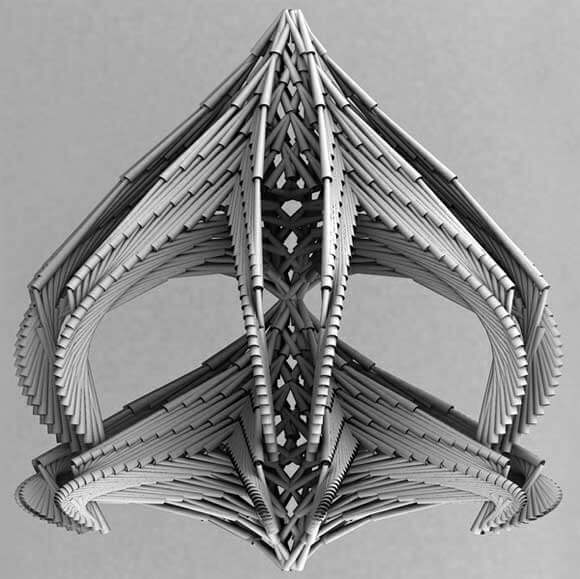
Neri Oxman's piece Monocoque 2 uses a 3D printing technique that allows parts to be made from multiple materials in a single build.

To be on forefront of a cutting edge field like 3D printing, the skill set required is pretty stacked. You need to be a designer, engineer, researcher, innovator, and technologist. You should be a good public speaker to present new discoveries to others. And it doesn’t hurt to be a professor at MIT.
Neri Oxman fits the bill, and her creations are demonstrating the powerful combination of 3D printing and new design algorithms inspired from nature.

Trained as an architect, Oxman is currently an assistant professor of media arts and science at the MIT Media lab. In 2009, she was named by Fast Company as one of the “100 Most Creative People” and made ICON’s list of the top 20 most influential architects to shape the future. As director of the research group, Mediated Matter, she is exploring digital design and new fabrication technologies. Collaborating with materials science professor W. Craig Carter, they’ve developed algorithms that mimic patterns and processes in nature to create unique sculptures possible only through 3D printing. The produced works are quite amazing and are receiving international attention.

At this early stage in its development, 3D printing is being used mostly to generate replicas of natural and man-made structures. Just as a computer printer makes copies of 2D images, 3D printers have copied a variety of objects that we’ve profiled previously, such as robotschairsprostheticskidneys, and jaw bones, to mention a few. But Neri Oxman and her colleagues are discovering new design and engineering principles that will help to mature 3D printing into a technology capable of producing complex structures impossible by other manufacturing techniques.
Below is a gallery of Oxman’s work over the last seven years.

Multiversites Creatives exhibit
Recently, Neri’s work, sponsored by Objet, showed at the Centre Pompiduo in Paris as part of a Multiversites Creatives exhibit on 3D printing titled Imaginary Beings: Mythologies of the Not Yet. The pieces, LĂ©viathan 1 and Kafka, are part of the torso series and Pneuma 1 is part of the pulmonary series and are pictured below.  Also, for a video (in French) from the exhibit showing more of Neri’s pieces, click here.

Léviathan 1 (2012)

Kafka (2012)

Pneuma 1 (2012)

Making The Future
Earlier this year, Neri was asked to produce a piece to showcase the future of manufacturing for a Technology Review report.

Making The Future (2012)

You can watch this recent video produced by Objet in which Neri describes her approach to design:
Body Contoured Forms (Work in progress)
An ongoing study in the Oxman lab is exploring the design of skins and body armors based on human tissue. Speaking to PopSci, Oxman said, “Most patterns in nature—whether scales or spiderwebs—have some kind of logic that can be computationally modeled.” Armour is bioinspired to protect by being designed specifically to a person’s body. Carpal Skin is a prototype of a glove aimed at protecting against carpal tunnel syndrome.
Armour (2012)

Carpal Skin (2009-2010)

Completed Projects
Some of the following works are in the Museum of Science in Boston.
Beast (2008-2010)

Raycounting (2007-2010)

Fatemap (2008)

6D Phase Space (2008)

Cartesian Wax (2007)

Rapid Craft (2005-2006)

Exploration Into Porous Skin 1 (2005)

The 'smart bomb' therapy that blasts breast cancer

http://theweek.com/article/index/228785/the-smart-bomb-therapy-that-blasts-breast-cancer

A promising new study shows that a powerful drug can attach directly to tumor cells while leaving healthy cells relatively untouched

Researchers are excited about a new cancer therapy that explicitly targets breast cancer cells while leaving healthy ones alone. The experimental "smart bomb," which attaches directly to tumors before killing them, is being hailed as "a major step forward" in the fight against cancer and could potentially reach the market within a year. Here's what you should know about the breakthrough:
Why is it called a "smart bomb"?

The treatment, referred to by doctors as T-DM1, combines two proven therapies to blast cancer cells: The drug Herceptine, a gene-targeted therapy sometimes used on patients whose tumors overproduce a specific protein, and a cancer-blasting form of chemotherapy so poisonous that it can't be administered alone. The two are bonded together by a chemical that unleashes when it comes into contact with breast cancer cells, delivering a potent payload that — unlike other cancer-fighting treatments — leaves healthy cells out of harm's way. Hence, T-DM1's "smart bomb" moniker.

How effective is it?
About 1,000 women with advanced breast cancer were given the drug. After two years, 65 percent of the women who received T-DM1 were still alive versus 47 of a control group administered standard treatment. More tests are necessary, however, because the margin was just below the rigid criteria cancer researchers use before declaring a new treatment a winner.

Why is this such a breakthrough?It's the first study that proves tumors can be precisely targeted with an antibody, minimizing uncomfortable side effects. "People don't lose their hair, they don't throw up. They don't need nausea medicines, they don't need transfusions," study leader Dr. Kimberly Blackwell of Duke University tells The Associated Press.

When might T-DM1 become available?
The drug's parent company, Roche, plans to file for FDA marketing approval in the U.S. and Europe by the end of the year. Shanu Modi, a New York breast cancer oncologist, who was not involved in the study, tells Bloomberg Businessweek: If T-DM1 is approved, "it is going to be rapidly taken up by the oncology community. For sure, I will be using a lot of it."

Sources: Associated PressBloomberg Businessweek, Wall Street Journal

Monday, June 4, 2012

Amelia Earhart: New evidence


http://www.csmonitor.com/USA/2012/0602/Amelia-Earhart-New-evidence-tells-of-her-last-days-on-a-Pacific-atoll-video


For decades, pioneer aviator Amelia Earhart was said to have “disappeared” over the Pacific on her quest to circle the globe along a 29,000-mile equatorial route.

Amelia Earhart: New evidence tells of her last days on a Pacific atoll (+video)

By

New information gives a clearer picture of what happened 75 years ago to Amelia Earhart and navigator Fred Noonan, where they came down and how they likely survived – for a while, at least – as castaways on a remote island.


Now, new information gives a clearer picture of what happened 75 years ago to Ms. Earhart and her navigator Fred Noonan, where they came down and how they likely survived – for a while, at least – as castaways on a remote island, catching rainwater and eating fish, shellfish, and turtles to survive. The tale hints at lost opportunities to locate and rescue the pair in the first crucial days after they went down, vital information dismissed as inconsequential or a hoax, the failure to connect important dots regarding physical evidence.


The International Group for Historic Aircraft Recovery (TIGHAR), a non-profit foundation promoting aviation archaeology and historic aircraft preservation, reported new details Friday leading researchers to this conclusion: Earhart and Noonan, low on fuel and unable to find their next scheduled stopping point – Howland Island – radioed their position, then landed on a reef at uninhabited Gardner Island, a small coral atoll now known as Nikumaroro Island.

Using what fuel remained to turn up the engines to recharge the batteries, they continued to radio distress signals for several days until Earhart’s twin-engine Lockheed Electra aircraft was swept off the reef by rising tides and surf. Using equipment not available in 1937 – digitized information management systems, antenna modeling software, and radio wave propagation analysis programs, TIGHAR concluded that 57 of the 120 signals reported at the time are credible, triangulating Earhart’s position to have been Nikumaroro Island.

"Amelia Earhart did not simply vanish on July 2, 1937,” Richard Gillespie, executive director of TIGHAR, told Discovery News. “Radio distress calls believed to have been sent from the missing plane dominated the headlines and drove much of the US Coast Guard and Navy search.”

"When the search failed, all of the reported post-loss radio signals were categorically dismissed as bogus and have been largely ignored ever since," Mr. Gillespie said. But the results of the study, he said, “suggest that the aircraft was on land and on its wheels for several days following the disappearance.”

In addition, several artifacts found years ago – some of it discovered by Pacific islanders who later inhabited the island – seem to confirm TIGHAR’s conclusion.

These include broken glass artifacts showing evidence of secondary use as tools for cutting or scraping; large numbers of fish and bird bones collected in, or associated with, ash and charcoal deposits; several hundred mollusk shells, as well as bones from at least one turtle; bone fragments and dried fecal matter that might be of human origin.

A photo taken three months after Earhart’s flight shows what could be the landing gear of her aircraft in the waters off the atoll.

“Analyses of the artifacts, faunals and data collected during the expedition are on-going but, at this point, everything supports the hypothesis that the remains found at the site in 1940 were those of Amelia Earhart,” according to TIGHAR.

Other artifacts (some of them reported in 1940 but then lost) include a bone-handled pocket knife of the type known to have been carried by Earhart, part of a man’s shoe, part of a woman’s shoe, a zipper of the kind manufactured in the 1930s, a woman’s compact, and broken pieces of a jar appearing to be the same size and unusual shape as one holding “Dr. Berry's Freckle Ointment.” (Earhart was known to dislike her freckles.)

In July, TIGHAR researchers will return to the area where Earhart and Noonan are thought to have spent their last days, using submersibles to try and detect the famous aircraft they believe to have been swept off a Pacific reef in 1937.

 --

http://www.telegraph.co.uk/news/worldnews/australiaandthepacific/kiribati/9309084/US-Navy-prepares-mission-to-solve-riddle-of-Amelia-Earharts-death.html

US Navy prepares mission to solve riddle of Amelia Earhart's death

By , Tokyo

Seventy-five years after Amelia Earhart sealed her place in flying history as the first woman to attempt to circumnavigate the world, the US Navy is preparing a mission to solve the riddle of her death in the Pacific.

One of the most enduring mysteries of the annals of aviation, is what happened after Miss Earhart last radioed from her Lockheed Model 10E "Electra" that she was unable to locate an airstrip for landing.
The accepted wisdom was that Earhart's aircraft had simply run out of fuel and crashed into the ocean on July 2, 1937, as she searched for Howland Island.
Howland was the final refuelling stop before flying on to Honolulu and completing the journey by touching down in Oakland, California.
An expedition that will set sail from Hawaii on July 2, which marks the 75th anniversary of the last message by Phoenix International, the US Navy's primary source of deep ocean search and recovery expertise, will map a former British possession that has been indentified as the most likely crash site.
A team of enthusiasts from the International Group for Historic Aircraft Recovery (Tighar) has drawn up the plans for the expedition, which is backed by the US State Department.
It will use high technology, including multi-beam sonar, to inspect a steep and craggy underwater mountainside on the western reef slope of island of Nikumaroro, a former British colony that is today part of the republic of Kiribati.
 
"Our objective on this expedition is to conduct a thorough search of the area we judge to be most likely to contain wreckage from the Earhart Electra," said Tighar.

While much of the aircraft is likely to have been lost in the intervening years, researchers believe some key components - such as the Pratt & Whitney engines - could still be where they sank 75 years ago.

"Any man-made objects found will be photographed and their location carefully recorded," the group said. "No recovery of objects will be attempted unless necessary to confirm identification.#"Should identifiable wreckage from the Electra be discovered it will be documented as thoroughly as possible in situ so that a separate expedition can be equipped with the appropriate means to recover and conserve the materials."

If the aircraft had sufficient fuel to reach Nikumaroro, which was at the time the uninhabited British possession known as Gardner Island, it could have landed on reef flats before being washed over the ledge.

Earhart and Fred Noonan, her navigator, could have survived on the island for a time, but eventually succumbed to injury or infection, food poisoning or thirst.

The theory is supported by British colonial records in Fiji reporting the discovery of the partial skeleton of a castaway who perished shortly before the island was settled in 1938.
The bones were found in the shade of a tree in a part of the island that fits the description of the encampment that Tighar has been excavating.

The site is dotted with the remains of small fires on which meals of birds, fish, turtle and even rat were cooked.

Previous research trips have turned up parts of aluminium skin from an aircraft, plexiglass from a cockpit, a zip made in Pennsylvania in the mid-1930s, a broken pocket knife of the same brand that was listed in an inventory of Earhart's aircraft and the remains of a 1930s woman's compact.
Ric Gillespie, executive director of Tighar, says they still need to find incontrovertible proof that Earhart on Nikumororo - the "smoking gun."

This expedition apparently offers the best chances of that yet, with new forensic evidence of a photo that may show part of the aircraft on the reef sufficient to convince the US government to support the project.

--

Saturday, June 2, 2012

Louisiana's bold bid to privatize schools


June 1 | Fri Jun 1, 2012 6:04pm EDT
 
(Reuters) - Louisiana is embarking on the nation's boldest experiment in privatizing public education, with the state preparing to shift tens of millions in tax dollars out of the public schools to pay private industry, businesses owners and church pastors to educate children.
Starting this fall, thousands of poor and middle-class kids will get vouchers covering the full cost of tuition at more than 120 private schools across Louisiana, including small, Bible-based church schools.

The following year, students of any income will be eligible for mini-vouchers that they can use to pay a range of private-sector vendors for classes and apprenticeships not offered in traditional public schools. The money can go to industry trade groups, businesses, online schools and tutors, among others.

Every time a student receives a voucher of either type, his local public school will lose a chunk of state funding.

"We are changing the way we deliver education," said Governor Bobby Jindal, a Republican who muscled the plan through the legislature this spring over fierce objections from Democrats and teachers unions. "We are letting parents decide what's best for their children, not government."

BIBLE-BASED MATH BOOKS
The concept of opening public schools to competition from the private sector has been widely promoted in recent years by well-funded education reform groups.

Of the plans so far put forward, Louisiana's plan is by far the broadest. This month, eligible families, including those with incomes nearing $60,000 a year, are submitting applications for vouchers to state-approved private schools.

That list includes some of the most prestigious schools in the state, which offer a rich menu of advanced placement courses, college-style seminars and lush grounds. The top schools, however, have just a handful of slots open. The Dunham School in Baton Rouge, for instance, has said it will accept just four voucher students, all kindergartners. As elsewhere, they will be picked in a lottery.
Far more openings are available at smaller, less prestigious religious schools, including some that are just a few years old and others that have struggled to attract tuition-paying students.

The school willing to accept the most voucher students -- 314 -- is New Living Word in Ruston, which has a top-ranked basketball team but no library. Students spend most of the day watching TVs in bare-bones classrooms. Each lesson consists of an instructional DVD that intersperses Biblical verses with subjects such chemistry or composition.

The Upperroom Bible Church Academy in New Orleans, a bunker-like building with no windows or playground, also has plenty of slots open. It seeks to bring in 214 voucher students, worth up to $1.8 million in state funding.

At Eternity Christian Academy in Westlake, pastor-turned-principal Marie Carrier hopes to secure extra space to enroll 135 voucher students, though she now has room for just a few dozen. Her first- through eighth-grade students sit in cubicles for much of the day and move at their own pace through Christian workbooks, such as a beginning science text that explains "what God made" on each of the six days of creation. They are not exposed to the theory of evolution.

"We try to stay away from all those things that might confuse our children," Carrier said.
Other schools approved for state-funded vouchers use social studies texts warning that liberals threaten global prosperity; Bible-based math books that don't cover modern concepts such as set theory; and biology texts built around refuting evolution.
TEACHERS WEIGH LAWSUIT
The U.S. Supreme Court has ruled that vouchers can be used for religious education so long as the state is not promoting any one faith but letting parents choose where to enroll their children.
In Louisiana, Superintendent of Education John White said state officials have at one time or another visited all 120 schools in the voucher program and approved their curricula, including specific texts. He said the state plans more "due diligence" over the summer, including additional site visits to assess capacity.

In general, White said he will leave it to principals to be sure their curriculum covers all subjects kids need and leave it to parents to judge the quality of each private school on the list.

That infuriates the teachers union, which is weighing a lawsuit accusing the state of improperly diverting funds from public schools to private programs of questionable value.

"Because it's private, it's considered to be inherently better," said Steve Monaghan, president of the Louisiana Federation of Teachers. "From a consumer perspective, it's buyer beware."

To date, private schools have not had to give their students state standardized tests, so there's no straightforward way for parents to judge their performance. Starting next year, any student on a voucher will have to take the tests; each private school must report individual results to parents and aggregate results to the state.

The 47-page bill setting up the voucher program does not outline any consequences for private schools that get poor test scores. Instead, it requires the superintendent of schools to come up with an "accountability system" by Aug. 1. Once he does, the system cannot be altered except by legislative vote.

White would not say whether he is prepared to pull vouchers from private schools that do poorly on tests.

He pointed out that many kids applying for vouchers are now enrolled in dismal public schools where two-thirds of the students can't read or do math at grade level and half will drop out before they graduate high school. Given that track record, he argues it's worth sending a portion of the roughly $3.5 billion a year the state spends on education to private schools that may have developed different ways to reach kids.

"To me, it's a moral outrage that the government would say, 'We know what's best for your child,'" White said. "Who are we to tell parents we know better?"

That message resonates with Terrica Dotson, whose 12-year-old son, Tyler, attends public school in Baton Rouge. He makes the honor roll, but his mom says he isn't challenged in math and science. This week she was out visiting private schools. "I want him to have the education he needs," she said.

The state has run a pilot voucher program for several years in New Orleans and is pleased with the results. The proportion of kids scoring at or above grade level jumped 7 percentage points among voucher students this year, far outpacing the citywide rise of 3 percentage points, state officials said.
Studies of other voucher programs in the U.S. have shown mixed results.

In Louisiana the vouchers are available to any low- to middle-income student who now attends a public school where at least 25 percent of students test below grade level.

Households qualify with annual income up to 250 percent of the poverty line, or $57,625 for a family of four.

Statewide, 380,000 kids, more than half the total student population of 700,000, are eligible for vouchers. There are only about 5,000 slots open in private schools for the coming year, but state officials expect that to ramp up quickly.

NO FISCAL ANALYSIS
Officials have not estimated the price tag of these programs but expect the state will save money in the long run, because they believe the private sector can educate kids more cheaply than public schools.

Whether those savings will materialize is unclear.
By law, the value of each voucher can't exceed the sum the state would spend educating that child in public school -- on average, $8,800 a year. Small private schools often charge as little as $3,000 to $5,000 a year.

Yet at some private schools with low tuition, administrators contacted by Reuters said they would also ask the state to cover additional, unspecified fees, which would bring the cost to taxpayers close to the $8,800 cap. The law requires the state to cover both tuition and fees.

In the separate mini-voucher program due to launch in 2013, students across Louisiana, regardless of income, will be able to tap the state treasury to pay for classes that are offered by private vendors and not available in their regular public schools.

White said the state hopes to spur private industry to offer vocational programs and apprenticeships in exchange for vouchers worth up to $1,300 per student per class. Students can also use the mini-vouchers to design their own curriculum, tapping state funds to pay for online classes or private tutors if they're not satisfied with their public school's offerings.

State officials will review every private-sector class before approving it. They are still working out how to assess rigor and effectiveness.

The state has not done a formal fiscal analysis, but public school advocates say subtracting the costs of vouchers from their budgets is unfair because they have the same fixed costs -- from utilities to custodial services -- whether a child is in the building four hours a day or six. White responds that the state is not in the business of funding buildings; it's funding education.

While public schools fear fiscal disaster, many private school administrators see the voucher program as an economic lifeboat.

Valeria Thompson runs the Louisiana New School Academy in Baton Rouge, which prides itself on getting troubled students through middle and high school. Families have struggled to pay tuition, she said, and enrollment is down to about 60 kids.

"We're a good school," Thompson said, "but we've been struggling fiscally."
The vouchers have brought in a flood of new applicants and the promise of steady income from taxpayers. Thompson enrolled 17 new students in two days last month and hopes to bring in as many as 130. "I'm so grateful," she said. "You can't imagine how grateful."

Liberated Pixel Cup style guide, assets, and demo

http://lpc.opengameart.org/static/lpc-style-guide/index.html